
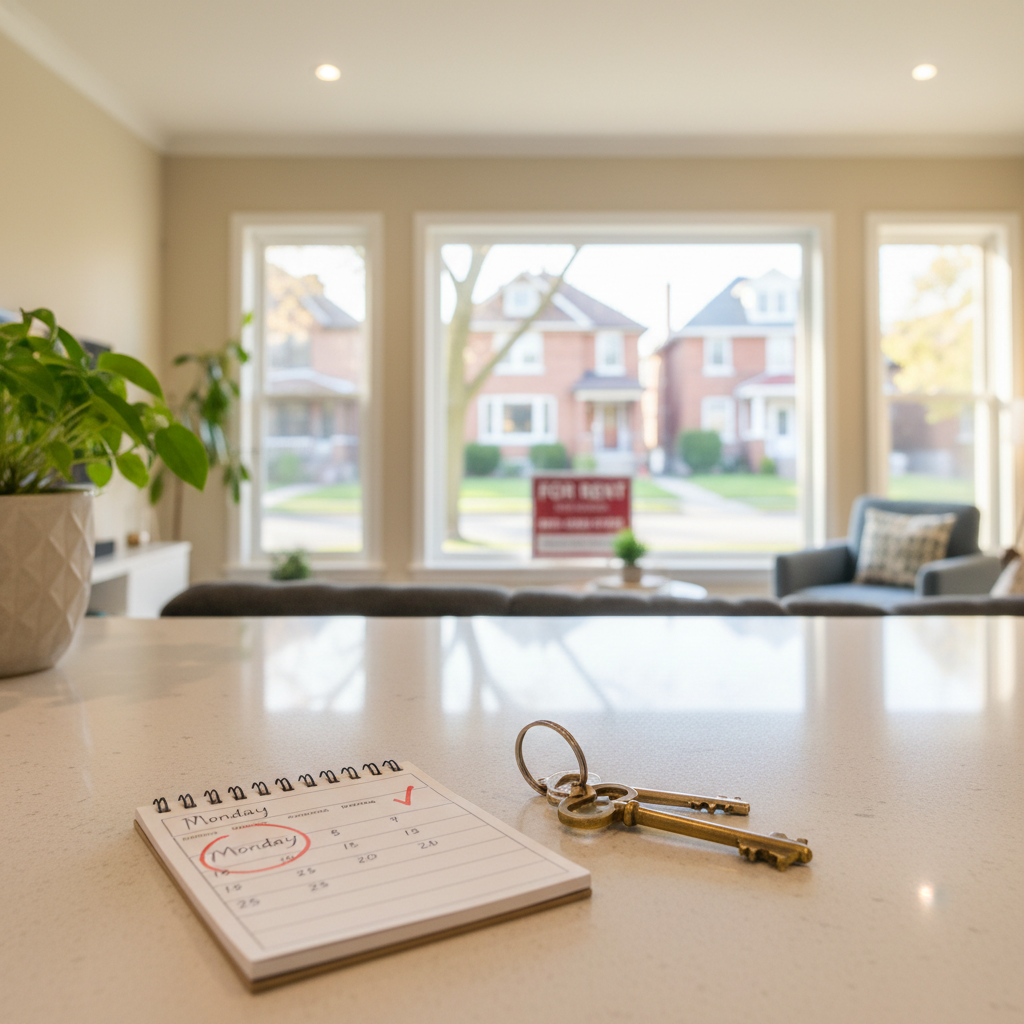
Most Hamilton landlords can cut the empty time between tenants down to a few days, and often to none. The way to do it is to list the unit the week the old tenant gives notice, not after they leave. Renters here move fast. A self-contained unit in Hamilton leased in a median of 15 days, at a median asking rent of $1,797 a month, over the twelve months to November 10, 2026, according to our Hamilton market report with asking rents and days to lease. A self-contained unit is an apartment, or a one or two bedroom space inside a house.
A tenant in Ontario on a month-to-month lease has to give you at least 60 days' written notice. Sixty days is four times longer than the median time to lease that unit. The empty weeks most landlords lose are lost before the ad ever goes up.
Where the empty weeks come from
I'm Ana Marin-Suarez. I lease homes, units and small buildings for landlords across Hamilton, in English and Spanish. I'm also Director of Operations at Found Spaces Property Management, which manages more than 600 rental properties across Hamilton, Burlington and the region.
The pattern I see most goes like this. The notice arrives. The landlord thinks, I'll deal with it when they're out. Then the keys come back, the landlord walks in, finds scuffed walls and a dripping tap, books a painter, waits for the painter, takes photos, writes an ad, and only then starts showing it, which is how a unit that could have leased in two weeks ends up empty for most of a month.
None of those steps is wrong. They're just in the wrong order.
The empty time between tenants is called vacancy. Each day of it is rent you never get back. On a Hamilton self-contained unit at $1,797 a month, a day costs about $60 ($1,797 ÷ 30). Fifteen empty days is about $900.
On a three-bedroom-plus house the gap hurts more. Those asked a median $2,600 a month in Hamilton over the same twelve months. Say, as a round-number example, a house sits empty three weeks, 21 days. That works out to roughly $1,800 in lost rent. Your mortgage, taxes and insurance still come out on the first.
The clock starts the day the notice arrives
The notice usually comes on a form called an N9. It's the form a tenant uses to end their lease. The day I see one, the next tenant search starts that same week.
Ontario law helps you here. Once a tenant has given notice, you can show the unit to new renters without the usual 24-hour written notice. Showings must fall between 8 a.m. and 8 p.m. You also have to make a fair effort to tell the tenant before you come in.
This is my one small habit, and it matters more than any ad. When notice lands, I send the outgoing tenant a short written list of showing windows and ask them to cross out the ones that don't work. Tenants who feel respected keep the place tidy for showings. Tenants who get surprise knocks don't, and a messy showing costs you a week.
Picture two landlords on the same Hamilton street with the same two-bedroom unit, both getting notice in early March for an end-of-April move. The first one waits for the keys, then paints, then lists in May. The second takes photos in March, books the painter for the day after move-out, and starts showings with the old tenant's blessing. By mid-April the second landlord has a signed lease starting May 1 and one painting day in between. The first is still answering messages in late May, roughly a month of rent behind, with the same unit and the same street.
The only difference was when they started.
Price it from the data on day one
The second thing that stretches vacancy is a price set by hope. A unit priced too high sits. Renters scroll past it, and the longer it sits, the more people wonder what's wrong with it.
Here's what our data shows for the twelve months to November 10, 2026. These are median asking rents, from lease listings on both local boards, in our Hamilton market report:
- Hamilton condo apartment: $1,895, 12 days to lease
- Hamilton three-bedroom-plus house: $2,600, 10 days to lease
- Hamilton townhouse: $2,725, 6 days to lease
- Hamilton self-contained unit: $1,797, 15 days to lease
- Stoney Creek three-bedroom-plus house: $2,997, 7 days to lease
These are asking rents. They're not signed leases. Some units rent for less than the ask, and I don't have a number for how much less. What I watch instead is how fast homes like yours leave the list nearby. If the units around you go in a week and yours has had no booked showings in five days, the price is the problem, not the photos.
A quick example with round numbers. Say you ask $100 a month more than similar units. That's $1,200 more over a year, if it rents. If that higher price adds two extra empty weeks on an $1,800 unit, you've already lost close to $900 before the lease starts. You've also started a tenancy with someone who may leave sooner for a cheaper place.
I'd rather price at the market, get ten good applicants, and pick the best one. If you own a duplex and want help pricing a first tenant before you move in, I wrote about that in how to find and price the first tenant for a Hamilton duplex.
One good thing about turnover: in Ontario you can set the rent for a new tenant at whatever the market will pay. So turnover is also your chance to bring the rent up to where similar units are. Use the data, though, not a guess.
Screen fast, and screen fairly
Speed comes from being ready. The slow way is to find a good applicant, then go hunting for a credit form. By then they've signed somewhere else.
I have the whole package ready before the first showing. That means the application, consent for a credit check, and a list of what I'll ask to see. I check credit, income, job, references and how they've paid rent before. A good renter in Hamilton often has two or three places to choose from, and the landlord who can say yes within a day or two usually gets them.
Fast never means cutting corners. The Ontario Human Rights Code applies to renting. You can't turn someone down because they have kids, get public assistance, or come from another country. You judge everyone on the same facts.
That last point matters to me, because I help a lot of newcomers. Many have no Canadian credit history yet. That's not the same as bad credit. A job letter, bank statements, and a reference from a past landlord abroad can tell you a lot. I've seen landlords lose a strong applicant simply because the form had no box for that.
Then you sign the Ontario standard lease. It's the government's own form, and it's required for most private rentals here. Use it as written, and put any extra terms, like who shovels the snow, in the space it gives you. Ask only for what the law allows up front. More on deposits below.
Book the work before the keys come back
Most turnover work is predictable. Walls need touching up. Something in the kitchen needs fixing. Carpets or floors need cleaning.
Do a walk-through with the tenant early in the notice period, during one of your showing windows. Make a list. Then book your painter and cleaner for the day or two right after the move-out date. Good trades in Hamilton get booked up, especially near the start of a month when everyone's units turn over at once.
Set the new lease start date to leave that small gap. If the old tenant leaves April 30, a May 1 start may be too tight. A May 3 or May 5 start with the paint dry beats a May 1 start where the new family walks into wet walls and a bad first week.
Take your move-out photos the day you get the keys. They protect you if there's damage to sort out. They're also the only record you'll have when that same tenant's references are checked by their next landlord.
When it makes sense to hand it off
Some landlords enjoy all of this. Others have a job, kids, and one rental they bought to build long-term wealth, not a second job. That's fair.
My honest read, as someone who does both leasing and management: if you've lost more than a few weeks of rent to turnover in the last couple of years, look hard at your process. Ask whether the gaps came from timing, pricing, or screening. If you can fix it yourself with the steps above, do. If you keep missing the notice window because life gets busy, a manager may pay for themselves in the days they save. I'd rather tell you that plainly than sell you on it.
For landlords still deciding whether to buy another unit, our Hamilton investment properties page covers the buildings and the numbers behind them.
My takeaway: the empty weeks in a Hamilton rental are almost always lost before the ad goes up. Start the day notice arrives, price from the data, and have your screening and trades booked before the keys come back.
Questions people ask
What if the old tenant doesn't move out on the date they gave?
You can't change the locks or move their things out yourself. In Ontario, you apply to the Landlord and Tenant Board for an order to end the tenancy. That's why I keep a small gap before the new lease starts, and I tell new tenants early on to keep a little flexibility in their own move.
Can a landlord in Ontario ask for a damage deposit?
No. You can ask for a rent deposit, which can be no more than one month's rent and must be used for the last month. You have to pay the tenant interest on it every year. A key deposit is allowed only if you give it back when the keys are returned.
Can I ask a new tenant for post-dated cheques?
You can ask, and many tenants agree. You can't make them a condition of renting, though. Many Hamilton landlords now use automatic monthly transfers instead, which tenants often prefer anyway.
Talk to me about your next turnover
If you've got a unit turning over soon in Hamilton, or you just got a notice, reach out. Tell me the unit and the move-out date, and I'll tell you where I'd set the rent and when I'd start showing it. Send me a message through our contact page.
En español
La mayoría de los propietarios en Hamilton pueden reducir casi a cero los días vacíos entre inquilinos. El secreto es empezar a buscar al nuevo inquilino la misma semana en que el actual da su aviso de 60 días. En Hamilton, una unidad independiente se alquiló en una mediana de 15 días en los doce meses hasta el 10 de noviembre de 2026, así que hay tiempo de sobra. Pongan el precio según los datos del mercado, tengan listo el proceso de selección y reserven al pintor antes de recibir las llaves. Si tienen una unidad que se desocupa pronto, escríbanme por nuestra página de contacto y con gusto les ayudo en español.