
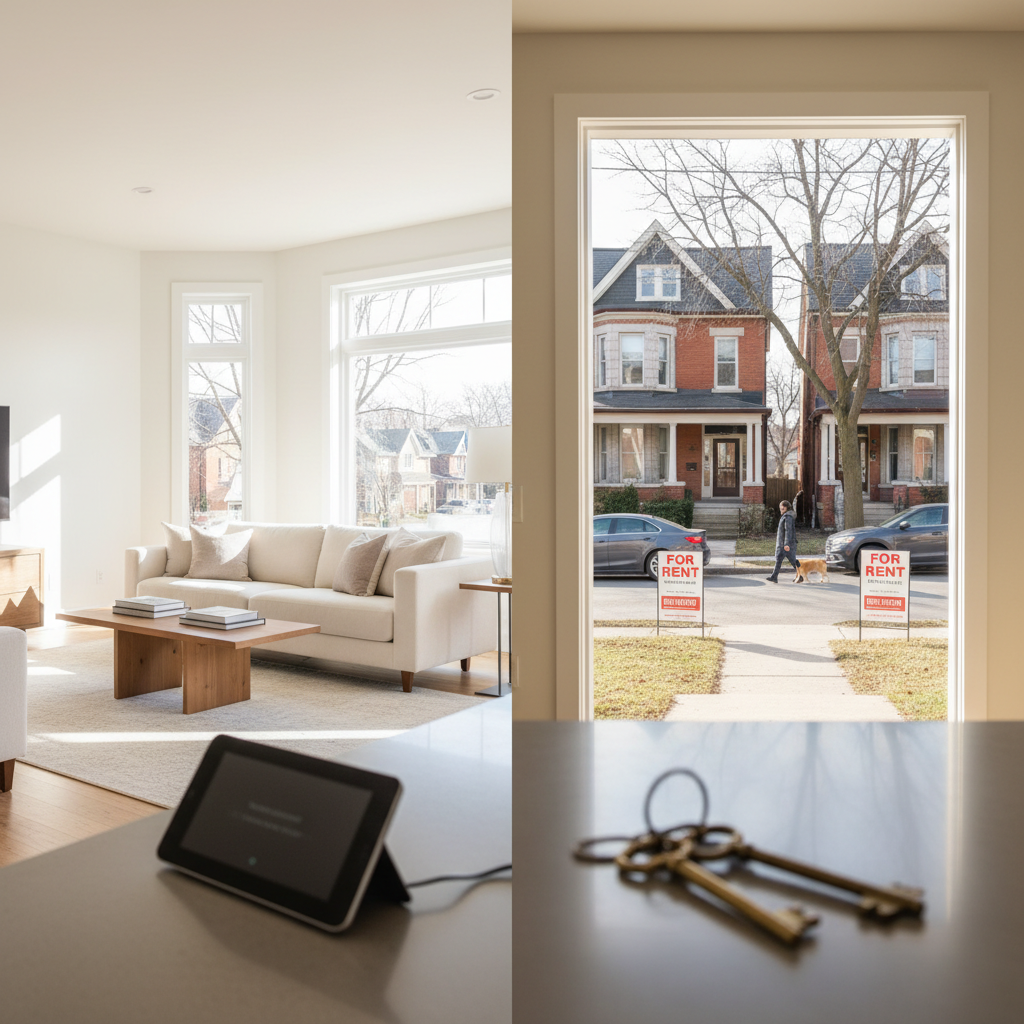
For most Hamilton landlords, a property manager starts to pay for itself at around three units. The bigger reason is empty days and costly mistakes, more than your time. A self-contained unit in Hamilton asked a median of $1,795 a month over the twelve months to November 3, 2026, according to our Hamilton rent and market report. That means every empty day costs you about $60.
The median unit took 14 days to lease. Three units turning over means three chances a year to lose that money, plus three chances to sign the wrong person.
I'm Ana Marin-Suarez. I'm a Realtor with Found Spaces, and I'm also Director of Operations at Found Spaces Property Management, which looks after more than 600 rental properties across Hamilton, Burlington and the region. So yes, I have a side in this. Weigh what I say with that in mind. I'll still tell you when you should keep doing it yourself.
The fee is the easy part to see
Most managers charge a share of the rent they collect. Some also charge a separate fee to find a new tenant. I won't quote you a number here, because it changes by company and by building. Ask every company for their fee in writing, plus a list of every extra charge. If they won't put it on one page, that tells you something.
The fee is the number every landlord asks me about first. It's also the only cost that shows up as a clean line on a statement.
The costs of doing it yourself hide in other places. A unit sits empty an extra two weeks. A repair waits because you were at work. A notice to a tenant uses the wrong form, so the Landlord and Tenant Board (the tribunal that settles rental disputes in Ontario) sends you back to start again. None of those show up as a fee, and that's why landlords with one unit, who rarely hit them, tend to think management is a bad deal, while landlords with three, who hit them a few times a year, start doing the maths differently.
Count the empty days before you count the fee
Here's the rent side of Hamilton, from the same data, for the twelve months to November 3, 2026:
- Three-bedroom-plus house: $2,600 a month, 10 days to lease (median)
- Townhouse: $2,725 a month, 6 days to lease
- Condo apartment: $1,895 a month, 12 days to lease
- Self-contained unit, like a basement or 1 to 2 bedrooms in a house: $1,795 a month, 14 days to lease
These are asking rents from listings, not signed leases. Still, they show you something useful. The units most small landlords own, the apartment in a house, are the slowest to rent in the city.
Now, 14 days is from listing to leased. It's not the whole gap. If you only start advertising after your tenant moves out, you add those 14 days on top of cleaning and small repairs. A good manager lists the unit as soon as the tenant gives notice, so the next lease can start close to the day the old one ends. With three units, saving even one week per turnover can come close to paying a big part of a year's fee. Run your own numbers. Our underwriting standard shows how we count running costs as a share of rent, so you can see what's left after an empty month.
Picture a landlord who owns a house with a basement unit and one more small rental across the Mountain. One tenant gives notice in March. She's busy, so she waits until the unit is empty, paints on weekends, and posts the ad in May. It rents in June. That's about two and a half months at roughly $1,800 each, so close to $4,500 gone, from one turnover. The lesson is simple: the ad should go up the week notice arrives.
Screening is where one mistake costs the most
A bad tenant costs far more than an empty month. In Ontario, if rent stops, getting the unit back goes through the Landlord and Tenant Board, and that can take months. So the yes you give at the start is the most expensive choice you make all year.
The Residential Tenancies Act and the Ontario Human Rights Code set what you can and can't ask. You can check credit, income, employment and references. You can't turn someone down because they have kids, because of where they're from, or because they get support payments. Many self-managing landlords cross that line by accident in a casual text.
On every application, the line I check first is payment history with the last landlord. A credit score shows how someone pays their bills. It doesn't always show how they pay rent, and rent is the only bill you care about.
Two more rules catch people out. A landlord can ask for a rent deposit of no more than one month's rent, and it must be used for the last month. No damage deposits. And most Ontario rentals must use the Ontario standard lease form. If you're still using a lease you found online years ago, fix that before your next tenant.
My honest view: hand off the leasing first
Some people in my line of work will disagree with this. I don't think most three-unit landlords need to hand off everything on day one.
The late-night leak call is annoying. But it rarely costs you much money. The leasing does. Finding the tenant, checking them, setting the rent and signing the right lease is where the big losses come from. So if you're on the fence, start there. Let someone with daily practice fill your next empty unit, and keep doing the small stuff yourself for a year.
Then look back. If the repairs and rent chasing are still eating your weekends, hand off the rest. If they're not, you just saved the full fee and fixed the riskiest part of the job.
When it makes sense to keep doing it yourself
Some landlords should keep their units, and I tell them so. You live close by. You have a trades person you trust. Your tenants have stayed for years and pay on time. You actually like this work. In that case, three units is very doable.
The sign it's time to change is usually not a disaster. It's small things piling up. Rent is late two months in a row and you didn't follow up in writing. You can't remember when you last raised the rent. You've stopped checking what similar units ask. A unit in a house in Hamilton asked $1,795 at the median, and if you're still charging what you set years ago to a new tenant, the gap is money you'll never get back.
If you're thinking about adding a fourth unit, decide on management first. Our Hamilton investment properties page and the duplex and triplex price report can help you see what the next building costs per unit.
What this month looks like if you want to test it
The sales side matters too. In October 2026, Hamilton homes took 40 days on average to sell, with an average freehold price of $733,622, down 2% from a year earlier, per the Hamilton market report. Prices are a bit softer, so more people are renting while they wait. That helps landlords who price right and move fast.
This month, do one thing. Write down the move-out and move-in dates for each of your units over the last three years. Add up the empty days. Multiply by your daily rent. Put that number next to a written fee quote. Now you're comparing real money with real money.
Questions people ask
Can a property manager raise my tenant's rent whenever they want?
No. In Ontario, rent for a sitting tenant can usually go up only once every 12 months, with 90 days' written notice on the right form. Many units have a yearly limit set by the province. A manager follows the same rules you do, but they track the dates so a raise doesn't get missed.
Can I hire someone just to find a tenant and do the rest myself?
Yes. Many landlords hire help only for leasing: setting the rent, showing the unit, screening and signing the lease. You then handle rent and repairs yourself. It's a good way to test whether you want full management later.
Can I ask a new tenant for a damage deposit in Hamilton?
No. Ontario does not allow damage deposits. You can ask for a last month's rent deposit and a key deposit that you must give back when the keys come back. You also have to pay the tenant interest on the rent deposit each year.
Talk it through with me
If you own three units in Hamilton and you're not sure whether to hand them off, send me a note through our contact page. Tell me the type of units and when each one last turned over. I'll tell you plainly whether management makes sense for you, or whether you should keep going on your own. You can also see how our management side works at Found Spaces Property Management.
En español
Para la mayoría de los propietarios en Hamilton, un administrador de propiedades empieza a valer la pena a partir de tres unidades. La razón principal son los días vacíos y los errores al elegir inquilino, más que su tiempo. Una unidad en una casa en Hamilton pidió una renta media de $1,795 al mes, así que cada día vacío le cuesta unos $60. Mi consejo es empezar entregando solo el alquiler y la selección del inquilino, y decidir lo demás después de un año. Este mes, sume los días vacíos de sus unidades en los últimos tres años y compárelos con una cotización por escrito. Si quiere revisarlo conmigo en español, escríbame desde mi página.