
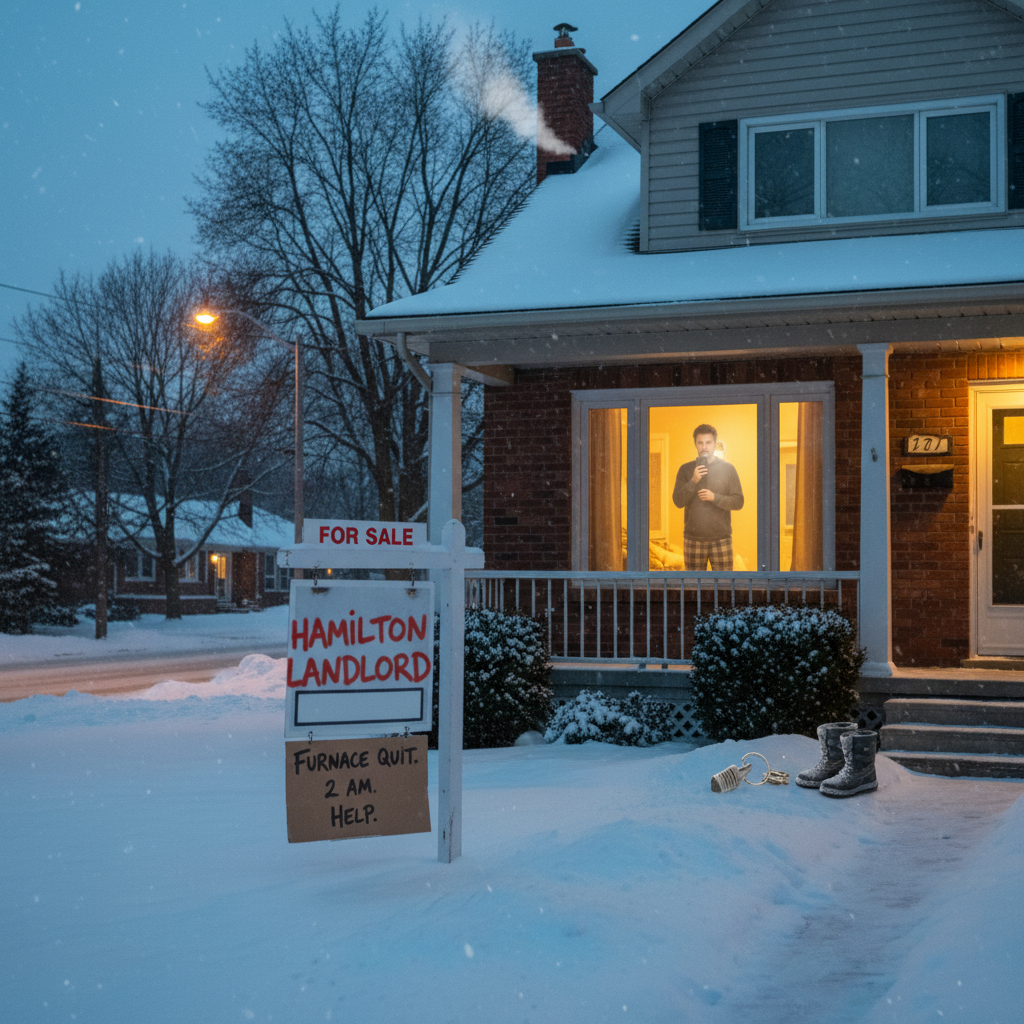
Get your tenant warm and safe first. Then get a licensed heating tech on the way, and write down every step with the time beside it. A three-bedroom house in Hamilton asks a median $2,600 a month in the twelve months to November 2026, according to our Hamilton market report with monthly rents and sales, and a cold week is the fastest way I know to lose a good tenant who pays that.
In Ontario, heat is a "vital service" under the Residential Tenancies Act. That means the law says it can't be cut off. So a dead furnace can't wait for Monday.
That's the whole answer. The rest of this post is about making it possible at 2am, when you're half asleep and your phone won't stop buzzing.
I'm Ana Marin-Suarez. I run operations at Found Spaces Property Management. We look after more than 600 rental properties across Hamilton, Burlington and the region, so winter furnace calls are part of my job. Landlords who manage alone tell me the worst part is the first ten minutes. They sit there with a tenant on the line and no idea who to call.
What a Cold Night Costs a Hamilton Landlord
Start with the rent. At $2,600 a month, one day of rent works out to about $87 ($2,600 divided by 30).
Now think about what happens if the tenant leaves. In that same twelve months, a three-bedroom house in Hamilton took a median 10 days to lease. A self-contained unit, like a basement apartment, asked a median $1,795 and took 15 days. Those days only start once the listing is up, and the place still has to be cleaned, painted and shown before then, which is why I always tell landlords to count a lost tenant as weeks of empty rent, plus the cost and the stress of finding someone new.
There's a legal side too. A tenant can apply to the Landlord and Tenant Board, the tribunal that settles rental disputes. They can ask for part of their rent back for the days they went without heat. The board calls this a rent abatement.
Picture a landlord with one rental house on the Mountain, leasing for about $2,500 a month in this example. The furnace stops on a Friday night in January. The landlord has no heating company's number saved, so Saturday goes by calling around, and the earliest tech they can book is Monday. The tenants spend two cold nights with their kids and one borrowed space heater. The repair itself is fine, and by spring the tenants give notice anyway, because what they remember is the weekend.
The furnace bill was never the big cost in that story. The slow first hour was.
The Furnace Sheet I Want in Your Phone Tonight
You can't build this at 2am. You can build it this week, in about the time it takes to have a coffee.
One small habit from my own work: when a landlord hands a home over to us, one of the first things I ask for is a photo of the furnace sticker, with the model and serial number easy to read. It sounds tiny. At night, it's what lets a tech show up with the right part instead of coming back the next day.
Put these in one note on your phone:
- Who owns the furnace. Many Ontario furnaces are rented from a company, and the rental agreement usually comes with a service line. Check the sticker on the furnace and your bills. If it's rented, that company is your first call.
- The furnace details. Model, serial number, rough age and filter size.
- Two heating companies that answer at night. Gas work in Ontario has to be done by a technician licensed through TSSA, the province's safety authority. Call both companies in daylight, now, and ask if they take after-hours calls.
- A backup heat plan. Two electric space heaters stored at the property or close by. Tell the tenant to plug them into different rooms so they don't trip one circuit.
- Shut-off spots. Where the gas valve and the main breaker are, with a photo.
Then give your tenant a short written note: who to call, in what order, and to call the gas company or 911 first if they smell gas. Tape it near the furnace.
My takeaway: the landlords who handle a 2am furnace well are rarely the handy ones. They're the ones with a list.
One Furnace, Two or Three Families
This one catches Hamilton investors off guard. A lot of older homes here were turned into a duplex or a triplex years ago, and some still run every unit off one furnace.
One breakdown, two or three cold households.
That changes the maths. You now have two rents at risk, and two sets of tenants who can each go to the board. It also changes access, because the furnace is often in the basement unit, so fixing the upstairs heat means getting into someone else's home in the middle of the night, and that tenant needs to hear from you before the tech knocks.
If you're looking at multi-unit buildings, ask early whether each unit has its own heat. Write the answer down before you make an offer. Our Hamilton investment properties page is a good place to start comparing buildings with that question in mind.
If you already own one with a shared furnace, I'd put service on it every fall. A shared furnace that fails takes more than one tenancy down with it.
What Changes When a Manager Holds the Phone
With full management, the tenant calls us and the owner's phone stays quiet. We hold the trades list, the furnace details and the written log. The owner hears what broke, what it cost and that it's fixed.
Here's my opinion, and some landlords will disagree with it. If you own one rental close to home, have a solid furnace sheet and don't mind a night call, managing it yourself is fine. If you own two or more, live more than a short drive away, or don't want your phone to be the emergency line for other people's homes, hand it over.
If you interview property managers, ask three things in writing:
- Who picks up the phone at 2am, a person or a voicemail?
- Which heating companies do you use, and are their techs licensed?
- How much can you spend on an emergency repair before you call me?
That last one matters more than people think. A clear dollar limit means nobody waits for you to wake up before the heat goes back on.
We also work in English and Spanish. For tenants and owners who are more at ease in Spanish, that can make a 2am call a lot calmer for everyone.
Questions People Ask
Can my Hamilton tenant stop paying rent while the heat is out?
No. Under the Residential Tenancies Act, a tenant can't hold back rent on their own to force a repair. What they can do is file a T6 application with the Landlord and Tenant Board about maintenance. The board can then order the landlord to fix it, lower the rent for a time, or make other orders.
Can I go into my tenant's unit at night to fix the furnace?
Yes, in an emergency. The Act lets a landlord enter without written notice when there's an emergency, and a dead furnace in winter usually counts. For regular repairs, you need to give 24 hours' written notice and enter between 8am and 8pm. Even in an emergency, call or text the tenant first so nobody is scared.
Who pays if the tenant broke the furnace?
You still fix it first, because heat can't wait. The Act says tenants pay for damage they cause on purpose or through carelessness, beyond normal wear and tear. If a tenant won't pay, you can file an L2 application with the board to ask for the cost. Most furnace failures are age and wear, though, and those are the owner's to cover.
Hand Over the 2am Phone
If you'd like our team to manage your Hamilton rental, or you just want help building your furnace sheet, send me your property's address through our contact page. I'll call you back and we'll look at what your rental needs.