
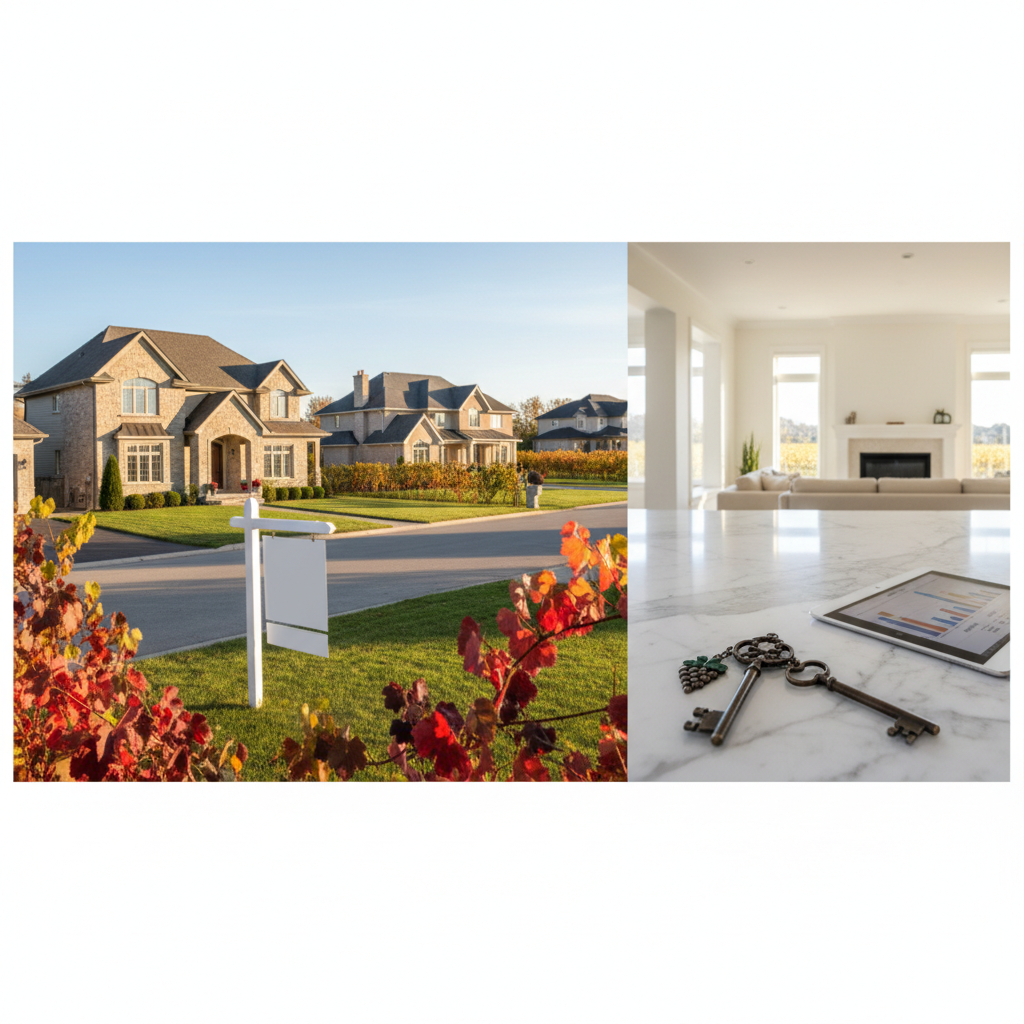
Nobody publishes a separate selling-time number for Niagara wineries, so the closest public measure is the top of the market. In the 52 weeks to November 21, 2026, Niagara homes asking $1.5 million and up had 160 sales from 873 new listings, a sell-through of 18%, according to Found Spaces' Niagara market reports. That works out to about one sale for every five or six new listings. This is how we at Found Spaces Realty Group (Real Broker Ontario Ltd.) read those numbers for winery and vineyard owners.
So how long? Longer than a regular house, in most cases. The average home in Niagara-on-the-Lake took 52 days to sell in October 2026, per the Niagara-on-the-Lake market report for October 2026. A working vineyard has fewer buyers, a harder bank approval and much more paperwork, so it usually sits well past that. We do not have a winery-only count to give you. The rest of this post covers what we watch instead.
What 18% Means for a Vineyard Listing
Sell-through is simple. You take the number of sales and divide it by the number of new listings. In Niagara's $1.5 million and up band, that was 160 sales divided by 873 new listings, which is 18%.
Flip it around. Over that year, 713 more big listings came on than sold.
That gap tells you who has the upper hand. At the top of the Niagara market, buyers have lots of choice, and a vineyard is competing with every lakefront estate, every Fonthill or Pelham acreage and every large Niagara-on-the-Lake home at a similar price, even though those properties are nothing like a working farm. These homes are also rare: the 160 sales were only 2.5% of all Niagara sales in that period.
One honest limit on this number: the report does not publish days on market for price bands. So nobody can tell you, from this data, that a $2 million vineyard takes a set number of weeks. Anyone who quotes you an exact figure for that should be able to show you where it came from.
The takeaway: at the top of the Niagara market, roughly one new listing in five or six turns into a sale over a year, so a vineyard that is priced well and shown well is in the group that sells, and one that is not can wait a long time.
Why a Winery Takes Longer Than a House Down the Road
A house buyer needs a bank, a lawyer and a home inspector. A winery buyer needs all of that and more.
They may need a farm loan. Many regular mortgages are built for houses. A vineyard buyer often works with a bank's farm team or with Farm Credit Canada, the federal government's farm bank, and that review takes longer because the bank is looking at the land, the vines and the business, not just the house.
They need to understand the licences. A winery that sells wine needs a licence from the AGCO, Ontario's liquor regulator. Wines that carry the VQA mark have to meet the rules of VQA Ontario, the wine standards body. A buyer's lawyer will want to know what transfers and what has to be applied for again.
They need to know what they are actually getting. Is the wine in the tanks included? The tractors? The brand name and the website? Every one of those is a separate conversation, and a buyer from Toronto or from overseas who has never run a farm will ask about each one, sometimes twice, because they are trying to work out whether this is a home with vines or a business with a home on it.
All of that adds time. None of it is a reason to worry. It is a reason to start the paperwork before the sign goes up.
Sell the Vines When Buyers Can See Them
Picture a 20-acre vineyard on the Beamsville Bench, listed in late November. The vines are bare, the rows are muddy and the tasting room is quiet for the season. Buyers drive out from Toronto, stand in the cold for ten minutes and leave with photos of posts and wire. The owner holds the listing through winter with few showings and starts to wonder if the price is wrong. In June, the same rows are green, the canopy is full and buyers can walk the blocks and taste last year's wine on the patio, and the showings pick up. The price never changed. What changed was what buyers could see.
That is the point. Timing matters more for a vineyard than for almost any other property in Niagara. If you can choose, plan the listing so the best showing weeks land when the vines are in leaf. If you cannot wait, make sure your photos and video from the growing season are ready on day one.
What Niagara-on-the-Lake's October Numbers Add
The town-wide numbers give useful background, even though they cover all homes and not only vineyards.
In October 2026, Niagara-on-the-Lake had 46 home sales, down 10% from a year earlier, with 127 new listings and 393 homes for sale, per the Niagara-on-the-Lake market report. If you divide the 393 homes for sale by the 46 sales, you get about eight and a half months of homes on the shelf if nothing new came on. That is a buyer's market by any measure.
The average freehold price that month was $647,518, down 47% from a year earlier. Be careful with that one. In a small town, one month's average can swing hard when a few large estates sell, or do not. It tells you very little about what your vineyard is worth.
For contrast, St. Catharines homes sold in 42 days on average in October 2026, according to the St. Catharines market report. The city moves faster than wine country. That makes sense: more people, more ordinary homes and more buyers who just need a place to live.
The Paperwork That Shortens the Wait
The fastest way to lose a vineyard buyer is to make them wait for answers. Every week a buyer spends chasing a document is a week their interest cools.
Have these ready, in writing, before you list:
- A planting list by block: the grape type, the number of acres and the year each block was planted.
- Any grape sale contracts, with how long they run and whether a buyer can take them over.
- Your licences and what each one covers.
- A list of equipment, and a clear line on what is included in the price.
- Drainage tile maps and any well or water records.
- The zoning, which tells a buyer what they are allowed to build or run on the land.
One small habit we recommend to every winery owner: write down which blocks gave the best fruit in your best year, and why. Buyers who know wine ask that question on the first walk. An owner who can answer it from memory, standing in the right row, sounds like someone who looked after the place.
If the buyer may be from outside Canada, tell them to get legal and tax advice early. Federal and Ontario rules on non-Canadian buyers can apply to property with a home on it, and that is a question for their lawyer, not something to sort out after an offer is signed.
Jason Hodder is a Niagara winery and estate REALTOR with Found Spaces Realty Group in Niagara, and you can read more about Jason Hodder's work with Niagara wineries and estates. For how we market and price this kind of property, see our page on Niagara winery, vineyard and estate real estate.
Questions people ask
Do Niagara wineries sell as a business or as real estate?
Either one. Some sales are only the land and buildings. Others include the brand, the equipment and the wine. Some are share sales, where the buyer buys the company that owns the winery, and that can change how taxes and licences are handled, so both sides need an accountant and a lawyer from the start.
Can a Toronto buyer get a mortgage on a Niagara vineyard?
Often, though it may not be a regular home mortgage. A vineyard is usually treated as a farm, so the buyer may need a farm loan from a bank's farm team or from Farm Credit Canada. Farm loans often ask for a bigger down payment than a house would. A buyer who talks to the bank before making an offer saves weeks later.
Is winter a bad time to list a Niagara vineyard?
Not always. Winter shows the bones of the land: the posts, the wire, the slope and how the water drains. In Niagara, icewine grapes are picked frozen on the vine, and VQA rules say the temperature must be minus 8 degrees Celsius or colder, so a winter listing for an icewine producer can show the property hard at work. Have summer photos ready either way.
See What Your Niagara Property Could Sell For
Thinking about selling a winery, vineyard or estate in Niagara? Start with a free look at what homes and land like yours have sold for nearby. Get your instant home evaluation, and our team will follow up with you directly.