
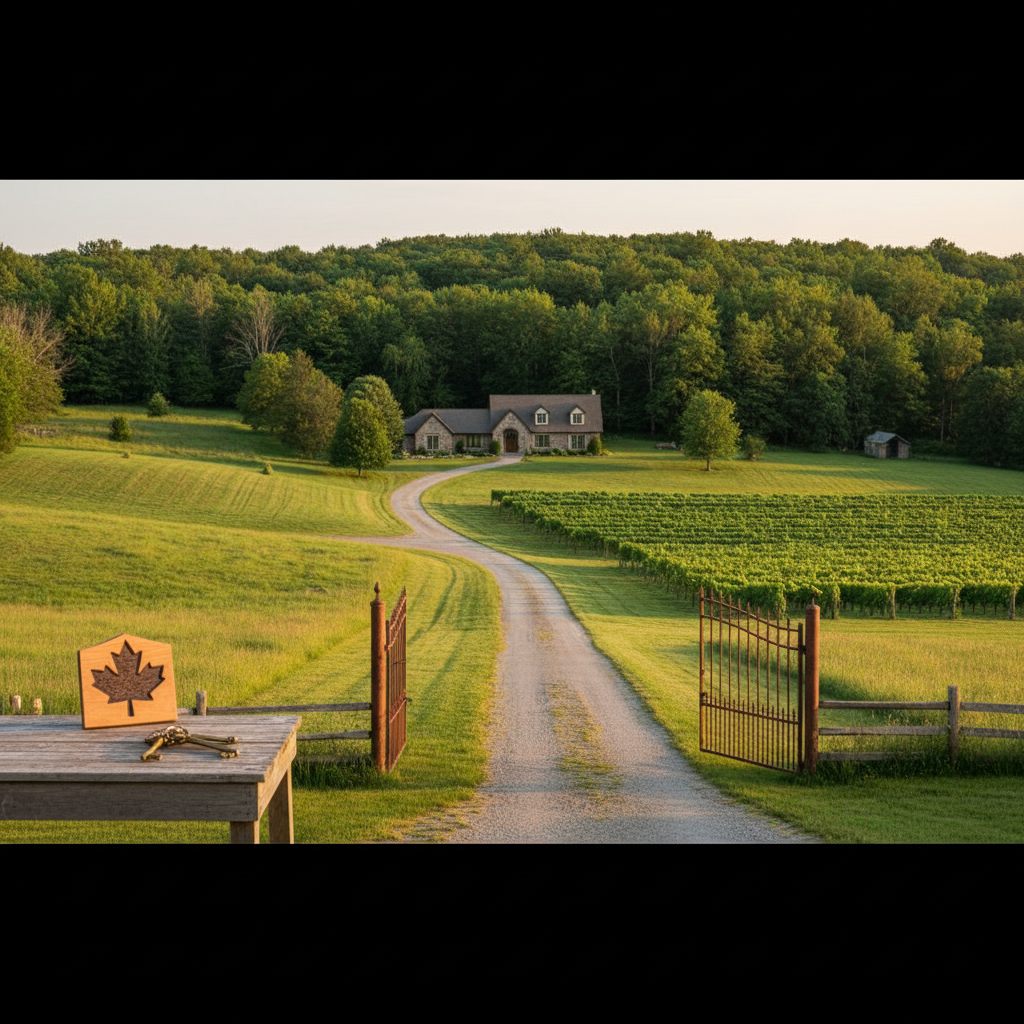
A Niagara estate on acreage is four things sold under one price: the house, the land, the privacy and, sometimes, a business. Pay for each one on its own terms. Pay the least attention to the house, because it is the part you could most easily replace.
The top of the market gives you time to do that math. In the 52 weeks to October 24, 2026, Niagara homes asking $1.5 million and up had 164 sales from 889 new listings, a sell-through of just 18%, according to our Niagara market reports. Sell-through means sales divided by new listings. Roughly four out of five of those listings did not sell in that year.
I'm Jason Hodder. I've lived in Niagara since 2006, I've been a Realtor since 2019, and I sell wineries, vineyards and estates for Found Spaces. Before real estate I spent twenty years running companies, so I look at a big property the way I used to look at a business I was thinking of buying.
Four things hide inside one estate price
When a Toronto buyer walks onto a property off a Line road in Niagara-on-the-Lake, they think they are buying a house with a big yard. They are buying more than that. Each piece has its own value, and sellers like to blend them together.
Privacy. This is distance, trees and quiet. It's how far the house sits back from the road. It's whether the Wine Route fills with tour buses every Saturday from May to October. A house that looks private on a Tuesday in November can feel very different on a long weekend in July. Go back on a Saturday afternoon before you make an offer.
Land. Acres are worth what the rules let you do with them. Much of Niagara's grape and fruit land, on the Bench and below it, sits in the Greenbelt's specialty crop area, which generally means the land stays farmland and you can't split off lots to sell later. So 40 acres here does not mean 40 acres of future building lots. Price it as land you will keep.
A business. Sometimes there are vines, a farm stand, a barn rented out for events or a full winery. That part should be priced on what it earns.
A legacy. This is the feeling of owning a place your kids will come home to. It's real, and it's the piece buyers overpay for most often.
My rule: put a number on each of the four before you look at the asking price. If the seller's number is higher than your total, you know exactly which piece they are charging you extra for.
Price the business like a business
For seventeen years I worked at Envirosystems Incorporated, an industrial, waste management and recycling company across North America. I built its buying-other-companies team from nothing. I learned to ask one plain question about any business: what does it actually make in a normal year?
A winery gets the same question. I look at cases produced, how many are sold straight to customers at the tasting room or online, how many staff it needs, and how the money swings with the seasons. Then I split the value into four parts buyers often lump together: the land, the licence to make and sell wine, the vines in the ground and the brand name on the bottle.
Big Head Wines in Niagara-on-the-Lake, which I represented at an asking price of $12,000,000, makes about 24,000 cases a year and has won world awards. That brand is a big part of what a buyer pays for there. Compare that with 38 acres at 3811 King Street in Lincoln, also listed with me, at $2,900,000. It has 19 acres planted to Cabernet Franc, Chardonnay, Pinot Noir and Pinot Gris, plus approvals for a winery and event centre. What you're paying for there is the land, the vines and the permission to build, because there is no brand yet.
One small thing I do on every winery: before we talk price, I ask the seller for three years of case sales in writing, split by where each case was sold. Tasting room sales and store sales earn very different money, and the split tells me more than the total.
You don't need a winery for this to matter. A rented field, a hay contract or an event barn should all be priced on what they bring in, with the costs taken off first.
What September's numbers really say at the top of Niagara
In September 2026 the average freehold home in Niagara-on-the-Lake sold for $1,621,406, up 64% from a year earlier, per our Niagara-on-the-Lake market report. Freehold means detached, semi and townhouse sales.
Please don't read that as homes jumping 64% in value.
There were only 44 sales that month. With a count that small, a few large estate sales can pull the average way up, and that is the most likely story behind a jump that size. The numbers I trust more for a buyer are the slow ones: 103 days on the market on average, and 406 homes for sale against those 44 sales, which by my math is about nine months of supply at September's pace.
Nine months of supply is a buyer's market. You can ask for the well and septic records, take your time on the inspection and come in below the asking price without anyone laughing at you.
Hamilton just made new homes cheaper to build. Here's what that changes for Niagara
In August, Ottawa and Ontario announced that Hamilton will get $572 million in exchange for dropping development charges on all new residential building from March 30, 2026 to March 31, 2029 (Government of Canada announcement). Development charges are fees a city adds to every new home it allows to be built. The governments say removing them cuts up to $100,442 off the cost of each new home. HamiltonIQ reported that a council committee backed the plan on October 1. Hamilton votes for a new mayor and council today, and CHCH reports housing has been the big issue of the race.
Most coverage treats this as a story about subdivisions. CBC Hamilton reports the money goes to roads like Rymal and Garner and to the Woodward wastewater plant, which could serve up to 97,000 more homes. None of that touches a country property on a well and septic.
My read is different. The buyer it matters to is the Toronto family choosing between an existing Niagara estate and building their own house on rural land in Flamborough or Ancaster, which are part of Hamilton. If Hamilton's break applies to their build, and the permit lands inside the three-year window, their new house could cost up to about $100,000 less to build than it would have last year. A Niagara estate with an older house has to compete with that.
I don't have a reliable number for what development charges add to a single rural custom home in Niagara, and they differ by town. What I watch instead is the house itself. If the house on a Niagara estate is dated, a buyer comparing it with a fresh build in rural Hamilton will now pay even less for it. Sellers should expect that. Buyers can use it.
The Niagara land does not lose anything here. Bench views, vines and frontage on the Wine Route can't be built in Flamborough at any price.
Legacy is real. Give it a ceiling
Picture a couple from Toronto standing at the edge of a vineyard on the Beamsville Bench at sunset, holding a glass of wine made from the grapes in front of them. The asking price is about $400,000 more than their own numbers say the house, land and vines are worth. They tell themselves it's for the grandkids. A year later the vines need replanting, the vineyard crew costs more than they planned, and that $400,000 sits in a property that would sell for less than they paid. If they had set a ceiling for the feeling before the visit, they could have paid it happily, or walked away happily.
I am all for paying something extra for a place you love. Owning land in Niagara can be the best thing a family ever does with its money. Just decide your number before the showing, write it down and bring it with you.
The Good Earth Food & Wine Co. on the Beamsville Bench is a winery, vineyard and restaurant I've represented through more than one sale. Places like it change hands because owners' lives change. The ones who planned their exit from the start almost always leave in better shape than the ones who bought on feeling alone.
If you want to see what is available now, our page on wine estate for sale listings and Niagara estate properties is where I keep them.
Questions people ask
Is a Niagara estate on farmland taxed as a farm?
Not automatically. In Ontario, farmland can be taxed at no more than a quarter of the residential rate. To get that rate, the land generally has to be farmed by a registered farm business, either yours or a farmer who rents it from you. Check how the property is taxed now by looking at the seller's tax bill.
Does Hamilton's development charge break cover one custom home on rural land?
The government announcement says it covers all residential development in Hamilton from March 30, 2026 to March 31, 2029. In my experience, the date that counts with fees like these is usually when the permit is issued. Call Hamilton's building department with your address before you count on the savings. Today's election could also change the details.
Can I buy a vineyard estate if I don't want to run a winery?
Yes. Many owners sell their grapes to wineries or rent the vines to a grower. Ask whether a current grape contract comes with the property and when it ends. Planted acres with no buyer for the fruit cost money every season.
Talk it through with me
If you're looking at a Niagara estate and want a second set of eyes on what each part is really worth, book a short call with me. Bring the listing. We'll put a number on the land, the privacy, the business and the house before you make an offer.