
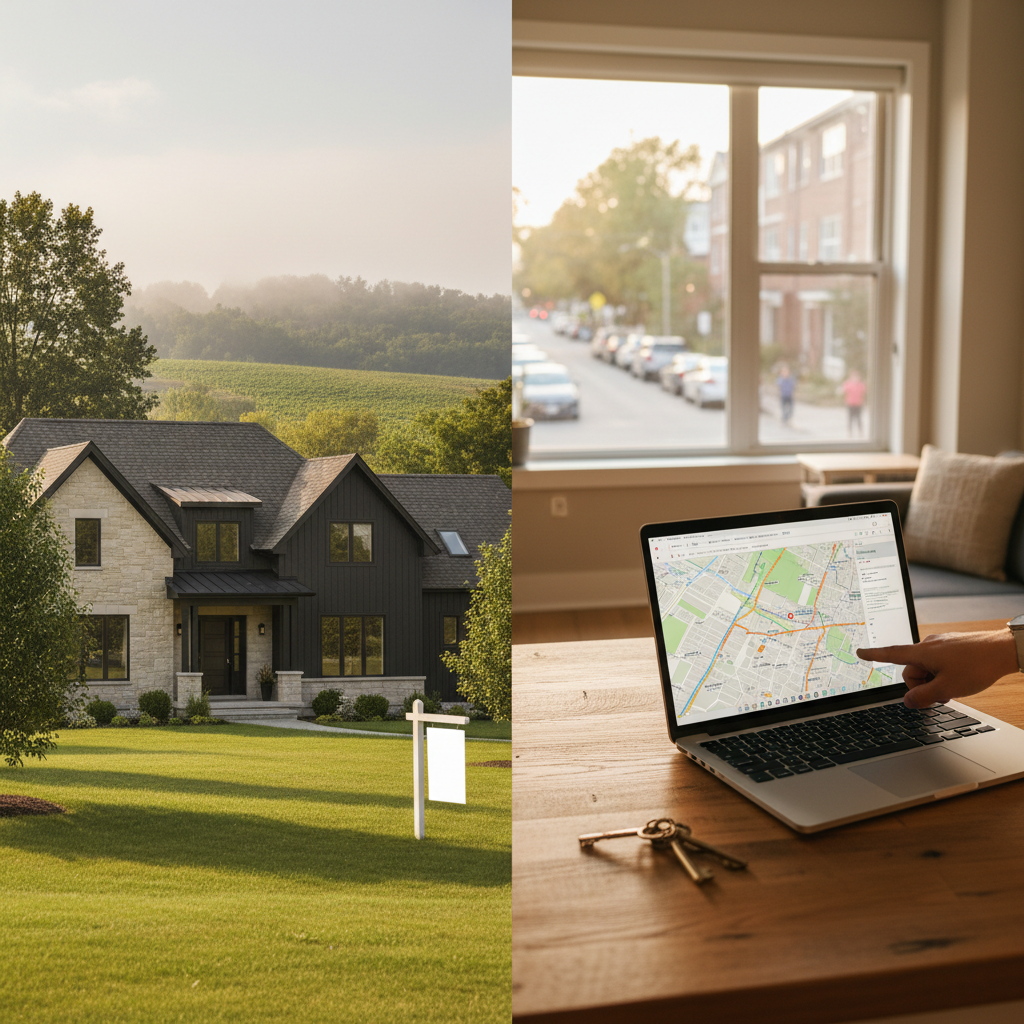
Selling a rural or estate property in Niagara takes a different plan than selling a house in town. The buyer is rarer, and most of the time they do not live here yet. In the 52 weeks to October 31, 2026, Niagara homes asking $1.5 million and up had 162 sales from 891 new listings (Found Spaces Niagara market reports). That is a sell-through of 18%, which means about 18 sales for every 100 new listings.
A house in town moves on a different clock. Niagara-on-the-Lake had 46 home sales in October 2026, and homes took 48 days on average to sell (October Niagara-on-the-Lake market report). Then on October 28, the Bank of Canada raised its key rate to 2.50%. That makes borrowing a bit dearer for the few buyers who can afford acreage. So the plan has to go and find the buyer. It cannot wait for them to find you.
Why an estate cannot be sold like a house in town
A three-bedroom house in Virgil or Old Town sells to someone who already wants to live there. That person has a search saved on Realtor.ca. They get an alert, they book a showing, and the job is mostly price and photos.
An estate does not work that way.
The person who will buy 25 acres on the Beamsville Bench, or a stone house on a big lot near Fonthill, is often not searching Niagara at all. They might be in Toronto, thinking about a slower life in ten years. They might be from another country, looking at wine regions in general. They might not even know what town they want yet.
My old job taught me this. I spent seventeen years at Envirosystems Incorporated, and I built the team that bought other companies, from nothing, until we had a pipeline of deals worth $200 million in yearly earnings. We never found a business to buy by waiting for it to post an ad. We made a list of who should want it, and we went and talked to them.
A rural property is closer to that than to a house sale. The buyer for a Niagara estate is a short list of people, and your marketing has to reach that list on purpose.
One more thing about the town numbers. The average freehold sale price in Niagara-on-the-Lake was $859,104 in October 2026, down 30% from a year earlier (same report). With only 46 sales, a few big homes selling one month and not the next can swing that number a lot. I would not tell an estate owner their land lost 30%. I would tell them the town market is slower, there were 393 homes for sale in October, and the buyers have choices.
What the October 28 rate hike changes for your sale
Here is what happened. The Bank of Canada raised its rate by a quarter of a point, to 2.50% (Bank of Canada press release). TD Economics points out it is the first increase since July 2023 (TD Economics). Ratehub expects the lowest variable mortgage rates to go from 3.45% to 3.70% (Ratehub), and Nesto reports the prime rate, the base rate banks lend from, is now 4.70% (Nesto).
Now, what it means out in the country.
Take a made-up example, just to see the size of it. Say a buyer has a $1,000,000 variable mortgage, one whose rate moves with the bank's. A quarter point more is about $2,500 more interest in a year, or roughly $208 a month, before the payment math gets fancier. That will not stop a buyer who can afford a $2 million property.
What it does is make them slower and pickier.
The Bank also said it may need to raise rates again. The next decision is December 9, 2026. Buyers hear that and think they can wait and get a deal in the spring. Some banks are also careful with big acreage, barns and outbuildings, so a buyer can end up with a smaller mortgage than they hoped for on a rural place. Put those together and you get fewer people ready to sign this winter.
My read is that the hike matters less for the price and more for the plan. If a property is priced right and the paperwork is ready, a serious buyer will still move. If it is priced on hope, this is the season it sits.
Sell the land and the life before the house
When I walk an estate with an owner, I try to see it the way I used to look at a company. What is the buyer really paying for?
With a winery, it is four different things that people mix up into one: the land, the licence, the vines in the ground and the brand. When I represented Big Head Wines at 823 Line 6 in Niagara-on-the-Lake, a winery making about 24,000 cases a year, the story was the wine and the awards, including the 2024 Best Chenin Blanc in the World. The land was the base under it, and the marketing had to say that clearly. You can see how we lay those out on our Niagara winery and estate properties page.
A rural home with no winery still has layers. The land. The privacy. The house itself. And sometimes a way to earn from it, like a rented field, a barn, or room for a second home.
Most listings lead with the kitchen. For an estate, I think that is backwards.
The buyer can picture a kitchen from Toronto. What they cannot picture is the view from the back field at seven in the evening in July, or how far the closest neighbour is, or how the land sits above the lake. So the photos, the video and the drone footage go there first, and the inside of the house comes after.
It also matters when the pictures were taken. A vineyard or a big lawn shot in August sells a feeling. The same land in February is brown and flat. If you might sell in winter, have it filmed this summer, while it looks the way the buyer will want to remember it.
The papers a country buyer asks for first
A buyer for a house in town asks about the roof and the furnace. A buyer for acreage asks harder questions, and they ask them early.
The first thing I ask an owner for, in writing, is the survey and the zoning. Zoning is the town's rule for what the land can be used for. A buyer from the city often wants to know if they can build, plant, keep horses or open something to the public. If we cannot answer that on day one, a lot of them quietly move on.
After that come the well and the septic system, which is the private sewer tank most rural homes have. Water test results, the age of the system, and when it was last pumped. City people have never thought about any of it, which is exactly why it scares them when nobody has an answer.
Then anything that shows the land can do what the story says. The 38 acres at 3811 King Street in Lincoln is a good example of why this counts. It had 19 acres planted to Cabernet Franc, Chardonnay, Pinot Noir and Pinot Gris, and approvals for a winery and event centre. Those approvals are worth a great deal to the right buyer, but only if they are on paper and easy to show.
Getting this ready takes weeks, sometimes longer. It is boring work, and it is the part that makes the sale.
Where the buyer actually comes from
Picture a family in Toronto who rent a cottage near Jordan every August. They love it. For three summers they say they should buy something out here one day, but they never once open a Niagara listing site, because one day always feels far off. Then a short video of a 20-acre property shows up in their feed, with the light coming across the field and a line about how close it is to the QEW. They book a visit that weekend. That is the buyer, and a sign on the road would never have reached them.
So the marketing has to travel. Real estate sites still matter, and every estate I sell is on them. But for this kind of property, the reach goes further: targeted video aimed at people in Toronto and beyond, a property story that a buyer can forward to their partner, and calls to the people I already know who are looking.
The winery world shows this clearly. Burning Kiln Winery at 1709 Front Rd in St. Williams sits on 92 acres above the Turkey Point marshlands, in an old tobacco pack barn where the original kilns now dry grapes. Coffin Ridge Winery, on 80 acres above Georgian Bay, draws about 35,000 visitors a year. The buyer for places like those is not someone who drives past. It is someone who hears the story somewhere else and wants to own it.
The Good Earth Food & Wine Co. on the Beamsville Bench is one I have represented through more than one sale. A winery with a restaurant has a buyer pool made of food people as well as wine people. You only find both if you go looking in both places.
Price it for the 18%, not the dream
Back to that number. In the 52 weeks to October 31, 2026, only 162 Niagara homes asking $1.5 million and up sold, out of 891 new listings (Niagara price band figures). That was 2.5% of all Niagara sales.
So the top end is a small, slow pond.
When there are about five new listings for every sale, the buyer gets to compare. An estate priced too high does not just sit. It becomes the place every buyer uses to make the others look like good value.
We do not publish days on market for this price band, so I will not guess at one. What I watch instead is simpler. How many showings come from people outside Niagara. How many come back for a second visit. What they ask about on that second visit. If nobody is coming back after a few weeks, the price or the story is wrong, and it is usually the price.
I know owners do not love hearing that. Many of these places took decades of work, and the number in their head comes from that work. I respect it. But a buyer pays for what the land, the house and the business are worth to them today, with a 2.50% bank rate and a December decision hanging over them.
The one thing to do this month
If you own a rural home or an estate in Niagara and you think you might sell in the next year, start the paperwork now. Find the survey. Find the well and septic records. Write down what the zoning lets you do.
Then find out what the place would really sell for today. Not the number from three years ago, and not the number a neighbour heard. You want the number a careful buyer would pay this winter, so you can decide whether to list, wait for summer photos, or fix something first.
It is the step that makes everything after it easier.
Questions people ask
Is spring or fall the better time to list a rural property in Niagara?
I like listing when the land looks its best, which is late spring through early fall. But you can list in winter if the photos and video were taken in summer. The bigger risk is listing in winter with winter pictures, because a buyer who sees bare fields online may never come to see it in person.
Will the October 2026 rate hike lower what my Niagara estate sells for?
Not by much on its own, in my view, since buyers at this level often put a lot down. The bigger effect is fewer buyers ready to act soon. The Bank of Canada expects inflation to reach 3.5% by year-end, and its next big report comes out January 27, 2027, so some buyers will wait for that before they move.
How long does a $1.5 million home take to sell in Niagara?
We do not publish days on market for homes over $1.5 million, because the numbers are small and jump around a lot. A better guide is the sell-through, which was 18% for the year to October 31, 2026. That tells you most listings at that price did not sell quickly, so plan for months, not weeks, and price with that in mind.
Find out what your Niagara property would sell for
If you are thinking about selling a rural home or an estate in Niagara, start with one simple step. Get your instant home evaluation and see where your place stands today. It takes a minute, and it gives us a real starting point to talk from.