
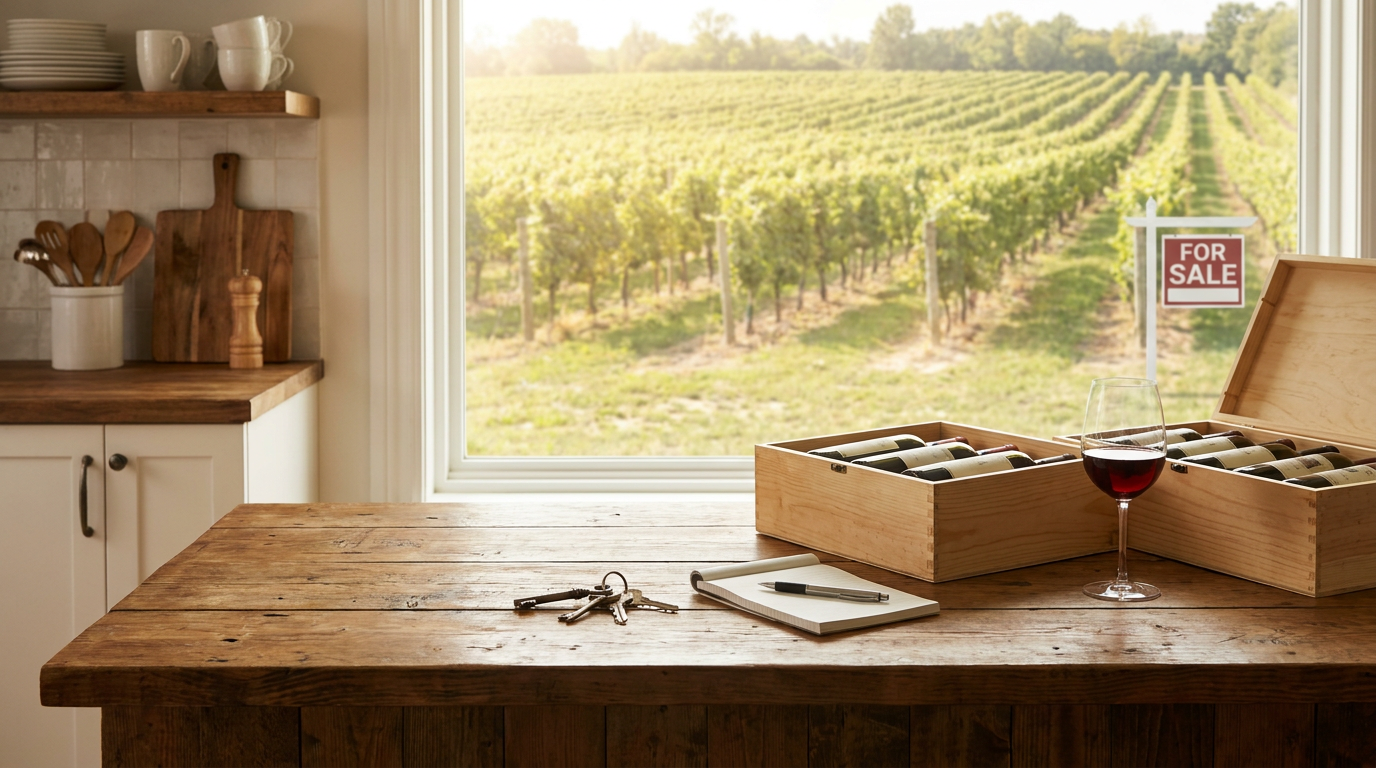
When you buy a working winery in Niagara, you are buying a business that happens to sit on land. The price follows how many cases it sells and where it sells them. Big Head Wines at 823 Line 6 in Niagara-on-the-Lake makes about 24,000 cases a year and was listed at $12,000,000. That works out to $500 of asking price for every case made in a year. I use that as a way to compare wineries, never as a rule.
For scale, the average freehold home in Niagara-on-the-Lake sold for $1,621,406 in September 2026, per our Niagara-on-the-Lake market report. A winery is a different animal. You are taking on staff, stock in barrels and a calendar that decides when cash comes in.
Where the bottle gets sold matters more than how many get made
I spent twenty years running companies before I sold real estate. Seventeen of those were at Envirosystems Incorporated, where I built the acquisitions team from nothing. So I read a winery the way I read any business I might buy.
Cases tell you size. The sales channel tells you what the owner keeps.
A bottle sold in the tasting room, through the wine club or online goes straight to the customer. Nobody in the middle takes a cut. A bottle sold through a store or a restaurant has to share the money with that seller. Two wineries can make the same number of cases and earn very different profits, depending on how much of their wine walks out the front door with a visitor who just tasted it and liked it enough to carry three bottles to the car.
That is why visitor traffic is an asset. Coffin Ridge Winery, on 80 acres above Georgian Bay, draws about 35,000 visitors a year. Each one is a chance to sell direct.
The seasons decide your cash, and staff follow the seasons
A winery spends money long before it sees money. You pay the vineyard crew in spring. You pay pickers at harvest. Then a red might sit in barrels for a year or more before anyone pays you for it.
Some styles stretch that wait even further. At Burning Kiln Winery in St. Williams, the old tobacco kilns now dry grapes in the appassimento style, and that drying adds time before the wine is even made.
Staffing swings the same way. Summer weekends need a full tasting room. A Tuesday in February might need two people. New owners often hire for July and then carry that payroll into winter. That habit drains a good business fast.
My takeaway: a winery's value lives in its case sales by channel and by month. The acres are the floor under the price, and the business sets everything above it.
The one document I ask for first
Before I talk about price with a buyer, I ask the seller for case sales split by channel, month by month, for three years, in writing. Tasting room, club, online, stores, restaurants. Each one gets its own line.
That habit comes straight from my acquisitions years. Revenue by customer told me more than any tour of a plant. A monthly split shows you if the club is growing, if summer carries the whole year, and if one big account could walk away. If a seller can't produce it, that tells me something too.
The Hamilton news this week, and what it means for a winery buyer
HamiltonIQ reports that a Hamilton committee backed ending residential development charges for three years, tied to $572 million in federal and provincial money. The governments say it could cut up to $100,442 off the cost of building a new home. Full council still has to ratify it.
My read is simple. It is residential only, and it is Hamilton only. A tasting room or event centre in Lincoln or Niagara-on-the-Lake gets nothing from it.
What it shows is how much government charges can move a project's math. Winery buyers forget this. They price the land and the vines, then get surprised by the cost of the building they planned to add.
So here is the one thing to do this month. If you are looking at land with approvals, like the 38 acres at 3811 King Street in Lincoln with approvals for a winery and event centre, call the town before you make an offer. Ask what charges and conditions come with building it, and get the answer in writing.
Buyers at this level can take their time
In the 52 weeks to October 10, 2026, Niagara homes asking $1.5 million and up had 166 sales from 900 new listings, a sell-through of 18%, according to our Niagara market reports. Fewer than one in five new listings at that level sold.
That gives a careful buyer room to do the homework. Use it on the business, not just the house on the property. You can see what's on the market on our Niagara winery and estate properties page.
Questions people ask
Can I buy a Niagara vineyard without buying a working winery?
Yes. Bare or planted vineyard land sells on its own. The King Street property in Lincoln is 38 acres with 19 planted to Cabernet Franc, Chardonnay, Pinot Noir and Pinot Gris, and it was listed at $2,900,000. You get the vines and the approvals, and you build the business yourself.
Do awards change what a Niagara winery is worth?
Awards build the brand, and the brand is one of four separate values in a winery, along with the land, the licence and the plantings. Big Head was the maker of the 2024 Best Chenin Blanc in the World and Ontario Red Wine of the Year. A brand like that pulls visitors and club members, which feeds direct sales.
How long do homes and estates take to sell in Niagara-on-the-Lake?
In September 2026, homes in Niagara-on-the-Lake took 103 days on average to sell, with 406 homes for sale. I don't have a published days-on-market figure for wineries. What I watch instead is how fast serious buyers ask for the financials.
Talk it through with me
If you're weighing a winery, a vineyard or estate acreage anywhere in Niagara, bring me the numbers you have and I'll tell you what I'd want to see next. Book a plain conversation with me here.