
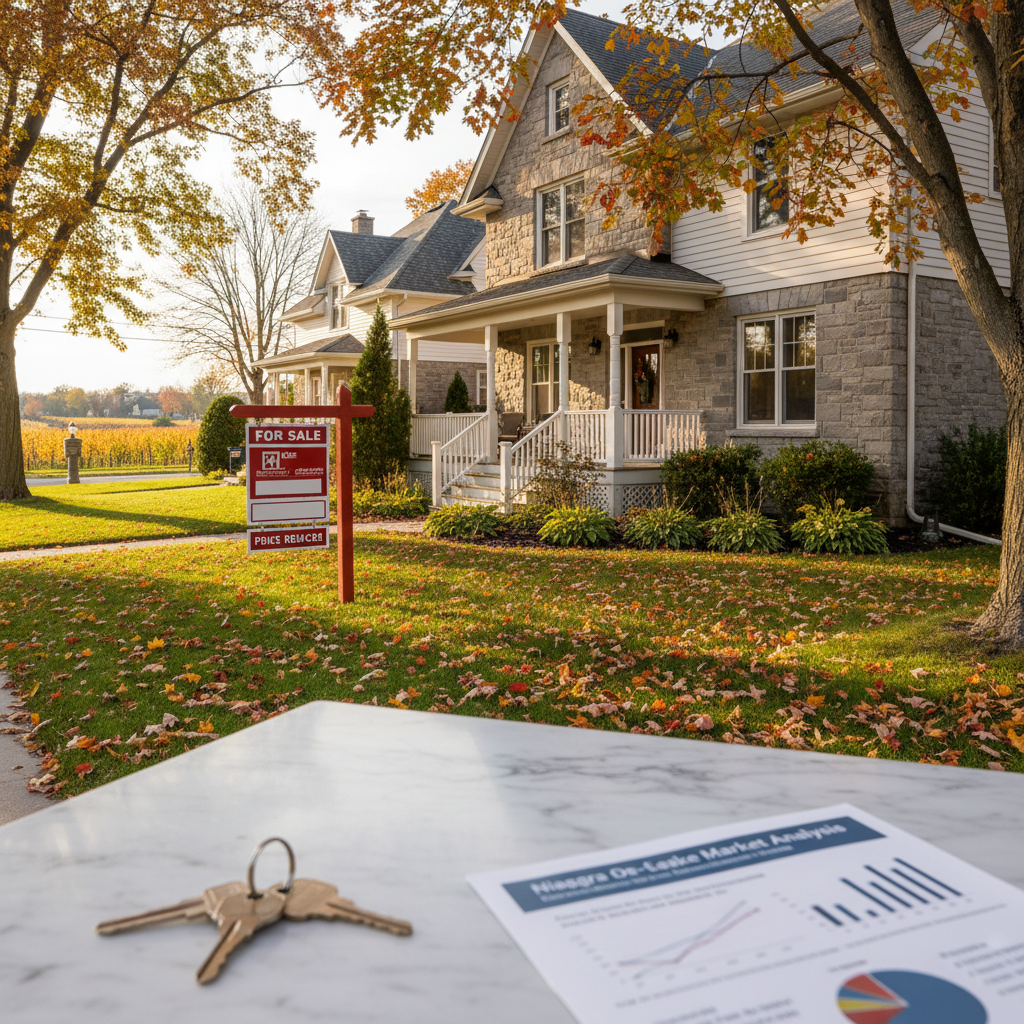
Most Niagara-on-the-Lake homes that sit unsold are priced on what the owner remembers. Buyers pay for what is selling today. In October 2026, the average freehold home in Niagara-on-the-Lake sold for $647,518, down 47% from a year earlier. That figure comes from the Niagara-on-the-Lake market report published by Found Spaces Realty Group (Real Broker Ontario Ltd.). Freehold means houses, semis and townhouses you own along with the land.
The gap between what you expect and what a buyer will pay can be closed. It starts with reading the numbers the right way. Then you price what you can prove.
Jason Hodder is a winery, vineyard and estate REALTOR with Found Spaces Realty Group in Niagara. He has lived in the region since 2006 and has been a Realtor since 2019.
Read the Niagara-on-the-Lake average before you read anything into it
A 47% drop sounds like the floor fell out. I don't read it that way.
An average follows whichever homes happened to sell that month. In a town where a vineyard estate and a starter townhouse can sell a few streets apart, a month with fewer big homes in the mix pulls the average down hard, even if no single house lost half its value. So I don't tell any owner their home is worth 47% less. I also won't let them use last year's average as their price.
The number I watch more closely is how many homes are waiting compared with how many sell. October had 46 sales, 10% fewer than a year earlier. There were 393 homes for sale. At 46 sales a month, those 393 homes would take about eight and a half months to clear (393 divided by 46).
That is a buyer's month.
Buyers have time. They have choice, and they know it. Every one of them is looking at your home next to others that also want to sell, and many of those other owners have already dropped their price once. When buyers have eight months of homes to pick from, the home that is priced right on day one gets the showings, and the one priced on hope becomes the home they use to make the others look like good value.
Above $1.5 million, the gap gets wider
The top of the Niagara market works on the same rules. It just moves slower.
In the 52 weeks to November 21, 2026, Niagara homes asking $1.5 million and up had 160 sales from 873 new listings. That is in our Niagara market reports across all 26 areas. It works out to a sell-through of 18%. Sell-through means sales divided by new listings. Put another way, for every 100 big homes that came on the market, 18 sold.
That is about three sales a week across the whole region (160 divided by 52). It counts estates, waterfront homes, acreage and the rare vineyard property.
I don't have a days-on-market figure for this price band. Our reports don't publish one, so I won't guess. What I watch instead is the gap between 873 and 160. That is 713 more listings than sales. Some came off the market. Some were relisted at a new price. Some are still sitting there with a sign that has faded in the sun.
The owners in that 713 mostly have good homes. What they often lack is a price a buyer can defend to their own bank, their own accountant, or their own spouse.
A Burlington golf course just taught every Niagara landowner a lesson
This story isn't from Niagara. I'm telling it because it explains, better than anything I could make up, the most common reason land and estate owners here price too high.
The province issued Minister's Zoning Orders on the Millcroft Golf Course lands in Burlington. A Minister's Zoning Order is a rule the province sets that overrides local zoning. Ontario Construction News reported that one order allows housing on parts of the course, about 138 homes. BurlingtonToday broke that down on November 18 as 73 detached homes and 65 townhouses on five parcels south of Dundas Street and east of Walkers Line.
So it's done, they can build? No.
Burlington council voted unanimously on September 29, 2026 to refuse the developer's plans, citing planning, environmental and technical reasons. The developer, Millcroft Greens Corporation, has appealed to the Ontario Land Tribunal. That is the province's planning court. The City of Burlington says the zoning orders do not overturn council's refusal. They only make housing an allowed use if the developer meets the technical rules. The tribunal still decides whether a subdivision gets approved.
That's the lesson. A use being allowed and a project being approved are two different prices. A buyer pays for the second one.
I hear the Niagara version of this all the time. An owner of rural acreage says the land could hold a few lots. A homeowner says the town would surely allow a second unit. An estate owner says the barn could be an event space. Maybe all true. A buyer still has to pay for engineers, studies, time and the risk of hearing no. They take all of that off their offer, usually with room to spare.
Compare that with 3811 King Street in Lincoln, 38 acres on the Wine Route that I represented at $2,900,000. It came with 19 acres planted and approvals already in place for a winery and an event centre. Those approvals were part of what was for sale, on paper, ready to show a buyer's lawyer. That is what turns "could" into a number.
The four values owners blend into one
Before real estate, I spent twenty years running businesses in industrial, environmental and marine services across North America. Seventeen of those years were at Envirosystems Incorporated. I built its team for buying other companies from nothing. When you buy a business, you learn fast that the seller's number is one story and the buyer's number is a list of parts.
I look at a winery the same way. There are four values that owners tend to fold into one: the land, the licence to make and sell wine, the vines in the ground, and the brand. At Big Head Wines at 823 Line 6 in Niagara-on-the-Lake, the brand is easy to see. It makes about 24,000 cases a year and made the 2024 Best Chenin Blanc in the World, and the asking price is $12,000,000. Even there, a serious buyer wants each of the four values shown on its own, because each one gets checked by different people with different questions.
Your house has its own version of the four. There's the lot. There's the house itself. There's the money you spent fixing it up. And there's the feeling: the view, the garden, the years your kids grew up there.
A buyer pays well for the first two. They pay for some of the third, the part that shows and still looks current. The fourth is yours to keep, and no buyer has ever paid for it, which is hard to hear after twenty years in a home.
I don't say that to be cold. I say it because an owner who knows it can make a clear choice. Pricing on the feeling is the fastest way to join the 713.
How I close the gap with an owner
The first thing I ask any owner for, before I say a single number, is every letter they have ever had from the town or the region about the property. Permits, orders, approvals, a note about a septic system. It tells me what's proven and what's a story. Most owners have never pulled those papers together.
Then we sit down with homes like yours that sold nearby. We use sold prices only. Listing prices are what other sellers hope for, and in a market with eight months of homes waiting, hope is cheap.
Picture a couple in a large home outside Niagara-on-the-Lake who lists at a round number, say $1.8 million, because a neighbour's place went for close to that two years ago. Showings are steady for three weeks, then they stop. Each buyer compares the home with newer ones on the same road that sold for less, and nobody makes an offer. The couple does not drop the price a little at a time. They pull the papers, look at what sold this year, and relist once at a price they can defend line by line. The first buyer who walks through now has a reason to say yes. That's the whole method, with example numbers.
The last step is the one most people skip. We agree on a date to look again, in writing, before the home goes live. If the showings don't come by that date, we already know what we'll change. A price drop you planned for feels like a strategy. A price drop forced on you after months on the market feels like losing, and buyers can smell it.
The Good Earth Food & Wine Co. on the Beamsville Bench is a winery, vineyard and restaurant I have represented through more than one sale. Every time, the work started the same way: what can we prove, what does the market pay for it today, and what is the plan if it does not move. That's the same plan for a $600,000 house in town.
One thing to do this month
Find out what homes like yours sold for in the last few months. Use sold prices only, with nothing from active listings mixed in.
If you own more than a house, such as acreage, a farm, an estate or a winery, add one more step. Gather your letters from the town and sort them into two piles: what's approved, and what's only allowed. You can see how we look at Niagara wine country, vineyard and estate properties to get a sense of what buyers ask for.
Owning property in Niagara is still a smart, steady thing to do. Selling it well comes down to pricing it for this year's buyer.
Questions people ask
Does a Minister's Zoning Order mean land can be built on right away?
No. In the Millcroft case, the City of Burlington says the orders only make housing an allowed use if the developer meets technical rules, and the Ontario Land Tribunal still rules on the subdivision. That same golf course already had a 2024 tribunal ruling that approved 90 single-family homes and 130 apartment units on other parts of the course. Each new phase goes through its own process.
How long does a home in Niagara-on-the-Lake take to sell right now?
In October 2026, homes there took 52 days on average to sell, according to the Niagara-on-the-Lake market report. That is an average, so a well-priced home can go faster. A home priced on last year's numbers can take much longer.
Are there more sellers than buyers in Niagara-on-the-Lake?
In October 2026 there were 127 new listings and 46 sales. That's close to three new homes coming on the market for every one that sold (127 divided by 46). When new listings keep outpacing sales like that, buyers get more choice, so the first price you set matters more.
See where your price really stands
The first step is knowing what your home would sell for today, based on homes like yours that sold nearby. Get your instant home evaluation and I'll follow up with a short call to walk you through it.