
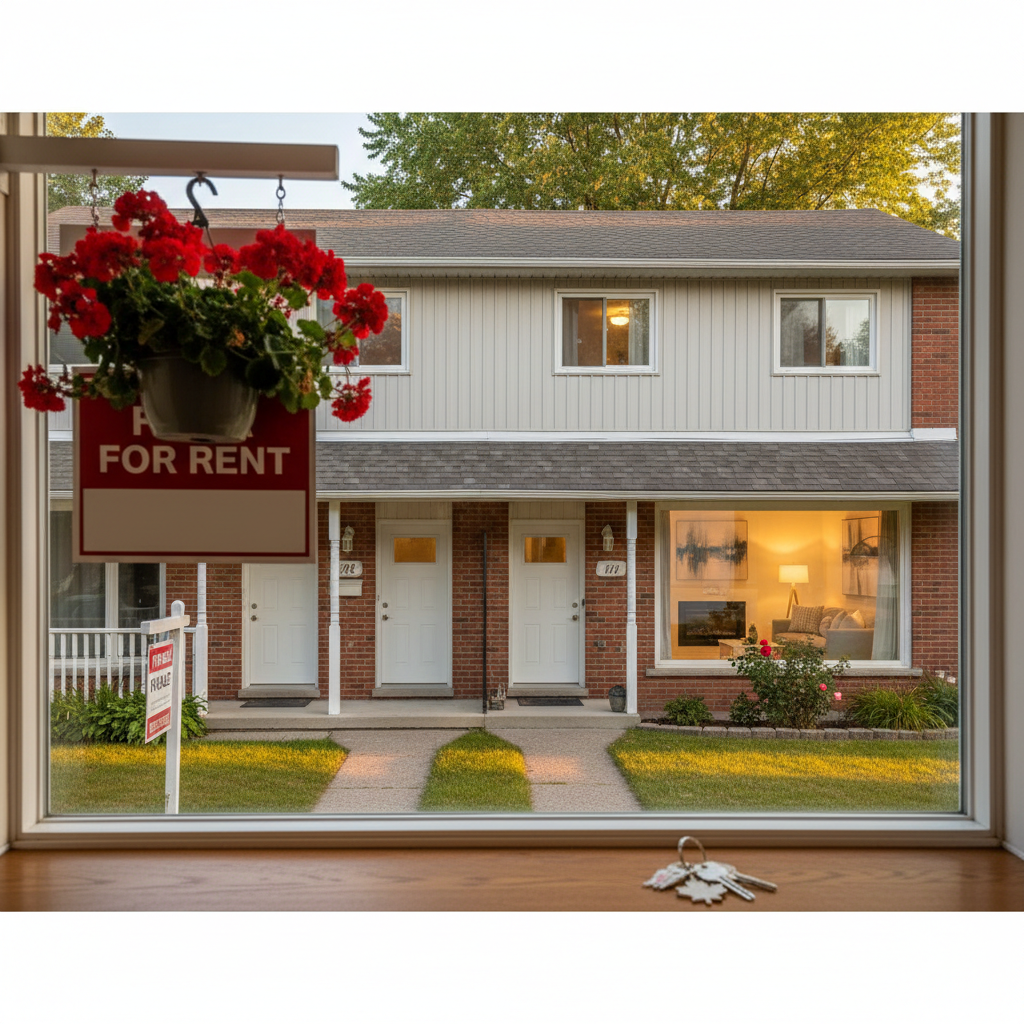
Yes. For a lot of Niagara renters, renting out half a duplex can get them a mortgage sooner. If you buy a legal duplex and live in one side, CMHC rules let the bank count up to 100% of the other side's rent toward what you can afford. CMHC is Canada's housing agency that backs low down payment loans.
That rent is a real number here. In St. Catharines, a self-contained unit, meaning an apartment in a house, had a median asking rent of $1,700 a month over the twelve months to November 3, 2026, according to our St. Catharines market report. The bank sees that $1,700 as money that helps pay your mortgage. For a renter whose pay is a little short, that can turn a no this year into a yes this year.
You still need a down payment. You still need steady income and credit the bank will accept. I'll be honest about all three below.
I'm Vanessa Whalen, a Realtor with Found Spaces. I work mostly in St. Catharines, Welland, Niagara Falls and Thorold. My view is simple, and some people will argue with it. A renter who buys a legal duplex in Niagara and lives in half of it is often better off than a renter who waits three more years for a detached house they can afford alone.
Why the second unit changes what the bank will lend you
The bank looks at your income and your monthly costs. Then it decides how big a mortgage you can handle. That's the whole test.
A second unit adds money to the income side. With a two-unit home, the bank can treat up to 100% of the rent as income you can use. Some banks count less. Some subtract it from your costs instead. Your mortgage broker knows which bank does what, and that's one reason I send buyers to one early.
The down payment rules stay the same as a regular house. You need 5% of the first $500,000 and 10% of any part above that, as long as you live in one of the units.
To show what that looks like, take the October 2026 average freehold sale price in St. Catharines, which was $519,054, down 14% from a year earlier, per the St. Catharines market report. Freehold here means detached, semi and townhouse sales. That average is not a duplex price. Duplexes sell above and below it depending on the street and the shape they're in. But it gives you a feel.
On a $519,054 purchase, the minimum down payment works out to $26,905. That's 5% of $500,000, which is $25,000, plus 10% of the last $19,054, which is $1,905.
That isn't all the cash you need. With less than 20% down, the bank's insurance fee gets added to your mortgage, and you still need money for the lawyer and closing costs. So the number to save is always more than the down payment alone.
The second unit doesn't lower the down payment. It raises what the bank thinks you can afford each month, which is usually the wall renters hit first.
Two units, three units or four: the rules change at three
House hacking just means you live in one unit and rent out the others. It works with a duplex, a triplex, a fourplex, or a house with a legal second or third unit.
The bank treats them differently, though.
With two units, it's 5% down on the first $500,000 and up to 100% of the gross rent can count. Gross rent means the full rent before any costs.
With three or four units, you need at least 10% down. And only up to 50% of the gross rent can count, or the rent left after costs, depending on the bank.
So a triplex brings in more rent, but the bank gives you less credit for each dollar of it, and you need roughly twice the cash to get in the door. For most first-time buyers I sit down with, that tilts things toward a duplex or a house with one legal basement unit.
A triplex can still be the right first home. It fits a buyer who already has the bigger down payment saved and wants the extra rent from day one. If that's you, it's worth running both. If you're scraping together 5%, start with two units.
St. Catharines or Welland: where the second unit fills faster
The rent only helps if someone actually pays it. That's why I look at how fast units lease, and the gap between these two cities surprised me.
In St. Catharines, a self-contained unit took a median of 7 days to lease over the twelve months to November 3, 2026, at a median asking rent of $1,700. In Welland, over the twelve months to November 2, 2026, the same kind of unit asked a median $1,500 and took a median 36 days to lease, according to our Welland market report.
One extra month empty is about $1,500 you pay yourself.
Prices point the other way. Welland's average freehold sale price in October 2026 was $609,122, down 2% from a year earlier. Sales there jumped 47% to 78 homes. St. Catharines averaged $519,054 with 113 sales.
So on these numbers, Welland asked more for the average home and less for the basement apartment, and that apartment sat longer. That doesn't make Welland a bad place to house hack. It means a Welland buyer should keep one or two months of rent in the bank before closing and price the unit to lease, because a nice suite at the wrong rent can sit a lot longer than a week.
One honest limit: these are asking rents from lease listings, not signed leases. I don't have a duplex-only average price for these cities in our reports. So I don't guess one. I watch the duplexes actually listed and what each unit in them costs. If you're looking toward Niagara Falls, our post on whether to buy a Niagara duplex now because of the South Niagara hospital covers that city.
Legal means the bank will count it
This is the mistake I see most. A house has a basement apartment with a kitchen, a separate door and a tenant. The listing says income property. But the city never approved the unit.
The bank may refuse to count that rent. Your insurance company may not cover it. And if the city asks you to close it, the plan falls apart.
Ontario now lets most homes in its cities have more than one unit. Each city still has its own permit and inspection rules. St. Catharines, Welland, Niagara Falls and Thorold all handle this through their own building departments.
When I show a duplex, the first thing I ask the listing agent for, in writing, is proof the second unit is legal. That means a permit, a final inspection, or a letter from the city. A verbal yes from anyone doesn't count. If there's no paper, I tell my buyer to treat the rent as zero until there is.
The second thing I ask for is the current lease, if there's a tenant. That tells you the real rent and when it ends. A tenant paying well below today's rent changes your math, and in Ontario you can't just raise it to match.
Getting mortgage-ready in 6 to 24 months, with a date on it
Most renters who tell me they can't buy have never checked. Some can buy now. Most are 6 to 24 months away. A few need longer.
The first step is a quick, free check on where you stand with one of the team's mortgage brokers. They look at your income, your debts and your credit. Then they tell you what's missing.
Credit is usually the slow part. For a mortgage with less than 20% down, CMHC wants at least one borrower to have a credit score of 600 or higher. Some banks want more.
You can see your own credit file for free from Equifax and TransUnion. Look for mistakes first, because a wrong late payment or a debt that isn't yours is the fastest thing to fix. After that, pay every bill on time and keep your credit card balances well under their limits.
Then put a date on it. Write down the month your broker thinks you'll be ready, and check in every three months.
Picture a couple renting a two-bedroom in Welland, paying about $1,800 a month and sure they're years away from owning. They meet a broker, and on their pay alone, the bank's answer is no. Then the broker runs the same numbers on a duplex, counting roughly $1,500 of rent from the unit downstairs, and the answer changes. They spend eight months clearing a collection on their credit and saving the last of the down payment. They move in upstairs, and the downstairs rent covers a big piece of the mortgage. That's an illustration with round numbers, not a real family, but it's the exact math I want every renter to see.
No Canadian credit yet? That's common with newcomers. Some banks accept other proof, like a history of rent paid on time. The brokers know which ones.
When rent-to-own fits better than a duplex
House hacking isn't for everyone. You become a landlord. You fix the leaky tap at 9 p.m. You screen tenants. If that sounds awful, it's fine to say so.
And some buyers need more time than 24 months. If your credit needs two to three years to mend, a rent-to-own program can be the better path. I work with established Ontario rent-to-own operators on the tenant-buyer side. I screen renters for the programs and stay their Realtor through to the purchase.
The usual fit is around 5% to put in, a steady household income, and a credit file that will mend in two to three years. You live in the home now and buy it later. You can read more about how I screen for these on my page, and the team's first-home path for Niagara and Hamilton buyers lays out every route side by side.
My honest take: if a duplex works for you today, it's usually faster and you own it from day one. If it doesn't, rent-to-own keeps you moving instead of waiting.
Questions people ask
Do I have to live in the duplex to put only 5% down?
Yes. The 5% minimum is for homes where you live in one of the units. If you buy a duplex only to rent out both sides, the bank treats it as a rental property and usually wants 20% down. You can move out later, but you need to plan to live there when you buy.
Can I use my First Home Savings Account to buy a duplex?
Yes, as long as you plan to live in it. The First Home Savings Account, or FHSA, lets you save up to $8,000 a year, up to $40,000 in total, and take it out tax-free for your first home. A duplex where you live in one unit counts. A couple can each open one, which doubles what you can save.
Do I still get the first-time buyer tax refund on a duplex?
Usually, yes. Ontario refunds up to $4,000 of the land transfer tax for first-time buyers, which is the tax you pay when you buy a home. The home has to be where you live, and a duplex you live in qualifies. Your real estate lawyer applies for it when you close.
Find out how far you really are
Most renters guess they're years away. Many are closer than that, and a duplex can close the gap faster than saving alone. The one thing to do this month is find out your real number. Book a short, free call with our team and ask to start with a mortgage-ready check. You'll leave knowing whether a duplex, a rent-to-own home or a plan with a date on it is your next step.