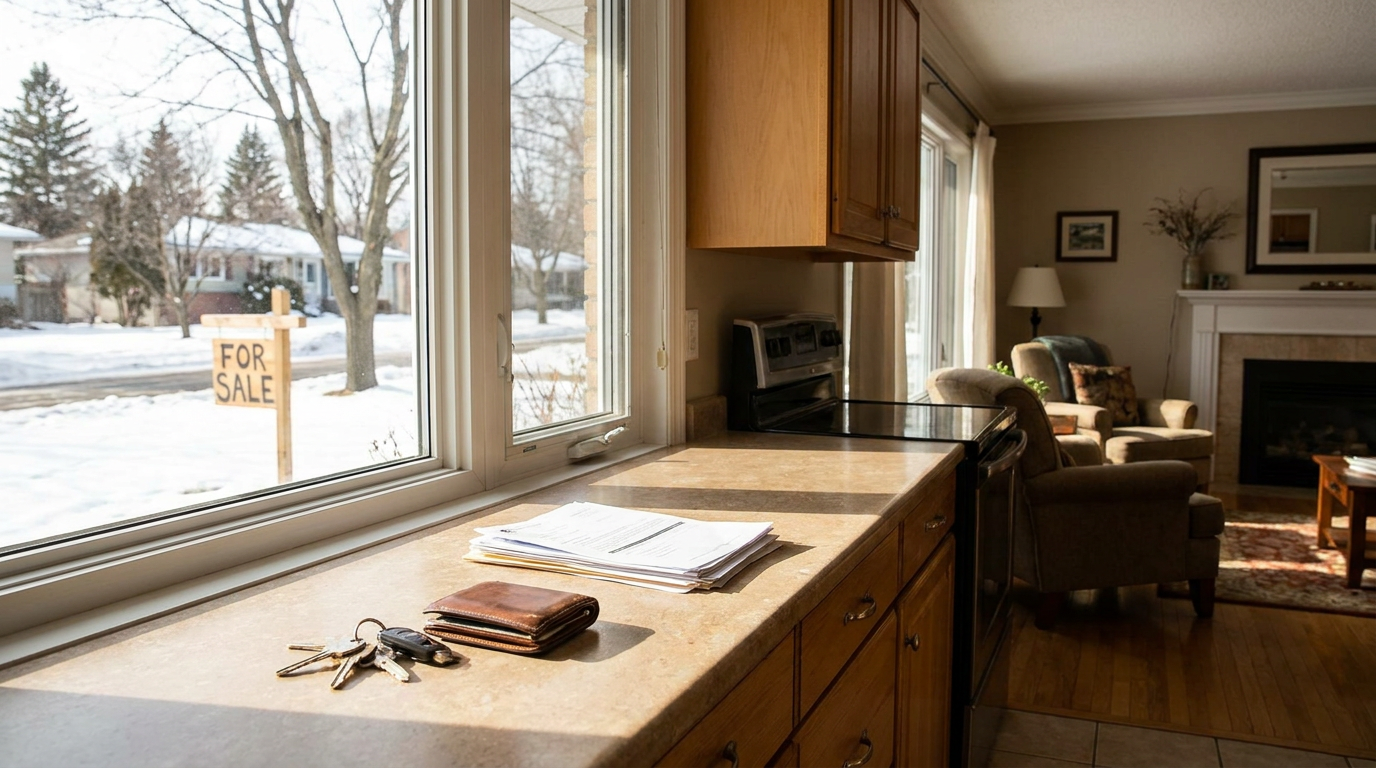
You find out if a second unit is legal by asking the city it sits in, in writing, before you make an offer. A separate door and a second kitchen prove nothing. The money at stake is real: an up-and-down duplex in St. Catharines had a median asking price of $524,900 over the last 12 months, per our St. Catharines multiplex report, and a big part of that price is the rent from the second unit.
Ontario now lets most homes on full city water and sewer hold up to three units. That's the provincial floor. The details still change as you drive from St. Catharines to Welland to Fort Erie: parking, unit size, what counts as a legal basement exit, whether a rental licence applies, and whether the work was ever permitted at all. That last one matters most.
Why the provincial rule doesn't make an existing unit legal
The province changed the rules so you're allowed to build a second or third unit on most serviced lots. It did not go back and bless every basement apartment someone built in 1994 without a permit.
This is the part buyers miss. "Allowed" and "legal" are two different questions. Allowed means you could get a permit for a unit on that lot today. Legal means someone actually did get the permit, built it to code, and passed the final inspection.
A house can sit in a zone where a second unit is fully allowed, have a tenant paying rent downstairs for ten years, and still have an illegal unit, because the owner never pulled a building permit, never put in the fire separation, and never had the wiring looked at by the Electrical Safety Authority, which means the next owner inherits every one of those gaps on the day they close.
That next owner is you.
So when an agent says "second units are legal in Welland now," they're half right. They're answering the first question. Your mortgage, your insurance and your tenant's safety all ride on the second one.
The listing words that tell you nothing
I read a lot of Niagara listings. Some phrases show up again and again, and none of them mean the unit is legal:
- "In-law suite"
- "Income potential"
- "Separate entrance"
- "Basement apartment, tenanted"
- "Duplexed"
"Legal duplex" or "legal two-unit" is better. Even then, I still check. The words come from the seller or their agent. The permit file comes from the city.
Picture a buyer who finds a raised bungalow in Welland with a bright basement unit, a tenant already in it, and an asking price that only works because of that rent. They fall for it, waive conditions to win, and close. A few months later the insurer asks about the unit and the answer is that there's no permit on file, so now they're pricing out fire separation, a second exit and an electrical inspection before they can feel safe renting it. Round numbers, purely for illustration: say that work runs tens of thousands of dollars. Every dollar of it was knowable before they signed, with one email to the city.
That's the whole point of checking first. You don't avoid the problem. You price it while you still have room to.
How I check a unit before I write an offer
Every buyer I sit down with gets the same order of work. It's boring. It saves people.
1. I ask the city for the permit history, in writing. This is the one habit I won't skip. I send the address to the building department and ask for every permit on file, and I want to see a final inspection, not just a permit that was issued. A permit that was opened and never closed is a yellow flag. It can mean the work was done and never inspected, or it can mean it was never finished to code.
2. I check the zoning on that exact lot. The province set the floor, but each city still has its own rules on things like parking spaces, minimum unit size and whether you can put a unit in a garage or a garden suite. Two houses on the same street can sit on different lots with different answers.
3. I look for the fire separation and the exits. On a showing I'm looking at the ceiling between units, the doors between them, whether the smoke alarms are connected, and how a tenant in the basement gets out if the stairs are blocked. Ontario's Fire Code has specific rules for two-unit houses, and the local fire department enforces them.
4. I ask about the electrical. A unit added without an Electrical Safety Authority inspection is a common gap in older Niagara houses. If there's no record, I'd rather know before we talk price.
5. I check whether a rental licence applies. Rental licensing has been a live topic near Brock University for years. I don't quote the current rule from memory, because these bylaws get debated and changed. I check what's in force at that address, that month, and I tell my buyer what I found and where I found it.
6. I write the offer with a condition that covers it. If the city hasn't answered yet, the offer gives us time to get that answer. In a market with this many homes for sale, a reasonable condition is often accepted.
The takeaway: a unit is legal when the city's file says so, and the time to read that file is before your offer, while you can still walk away or change the price.
Town by town: what I watch in each one
The province gives everyone the same starting line. After that, each town is its own conversation.
St. Catharines. This is home for me, and it's where I bought my own first place with a unit I could rent. Prices here are higher than the rest of the area I work. The average freehold sale price was $635,227 in September 2026, up 11% from a year earlier, with 33 days on market, per our St. Catharines market report. On the multiplex side, triplexes had a median asking price of $669,000, or $223,000 per unit, which is cheaper per door than the $262,450 per unit for an up-and-down duplex. Near Brock, I ask about rental licensing and bedroom counts on every file, because student houses are where the rules tend to bite.
Thorold. Brock's campus sits right at the line between St. Catharines and Thorold, and a lot of student rentals sit on the Thorold side. I don't have a separate Thorold price report to quote you. What I watch instead is how many bedrooms a listing claims, against what the permit file actually shows. A house marketed as "six bedrooms, students love it" deserves an extra hard look.
Welland. Niagara College's Welland campus drives a lot of rental demand here, and prices are lower. The average freehold sale price was $537,493 in September 2026, up 22% from a year earlier, with 45 days on market, per our Welland market report. The Welland multiplex report shows fourplexes at a median asking price of $749,450, or $187,363 per unit, the lowest per-door figure in either city's data. Low per-door prices are exactly where I dig hardest into permits. Cheap units are sometimes cheap for a reason.
Niagara Falls. The average freehold sale price was $611,141 in September 2026, down 8% from a year earlier, while sales were up 23%, per our Niagara Falls market report. The South Niagara hospital is due in 2028, and I think that will bring steady demand from people who work shifts and want to rent close by. Plenty of older Falls houses have had basement units added over the years, so the permit check matters just as much here.
Port Colborne and Fort Erie. Both have quieter streets and lower entry prices, and I don't have report figures for either to quote. The thing I check first is servicing. The provincial three-unit rule applies to lots on full city water and sewer. Some properties in the rural parts of both towns run on a septic system or a well, and adding a unit there is a different and harder conversation.
If you want the bigger picture across all of these areas, our market reports page has each one month by month.
Why your lender cares more than you think
Here's the money side, and it's the reason I check legal status before anything else.
CMHC's rules let rent from a unit help you qualify for the mortgage. For a two-unit home, you can buy with the same minimum down payment as a regular house (5% on the first $500,000), and up to 100% of the gross rent can count. For three or four units, you need at least 10% down, and up to 50% of the gross rent, or the net rent, can count.
Now the asking rent figures. Over the twelve months to October 14, 2026, a self-contained unit in St. Catharines had a median asking rent of $1,700 and leased in 9 days. In Welland the same kind of unit asked $1,495 and took 29 days. Those are asking rents from both boards, not signed leases, so I treat them as a guide.
Let's use round, illustrative numbers. On a St. Catharines duplex where the second unit rents for $1,700 a month, up to $20,400 a year of rent could count toward your qualifying income. On a triplex where you rent two units at that same rate, $3,400 a month comes in, and up to half of it, $1,700, might count.
The catch: many lenders and insurers want to know the unit is legal before they'll lean on that rent. If they won't count it, the house you thought you qualified for may be out of reach, and you find that out late. That's why I run the lender's rent math before an offer, using the unit's real status, not the listing's description of it.
This is also why one of my Hamilton colleagues looked at whether a house with a legal second unit rents for more as two homes than as one. Different city, same lesson: the legal unit is the asset. The illegal one is a liability with a tenant in it.
What I'd do this month if I were buying
My opinion, and I'll stand behind it: in Niagara right now, with 840 homes for sale in St. Catharines and 511 in Welland in September 2026, you have time to do this properly. Buyers who skip the permit check to win a house fast are solving a problem the market isn't giving them.
So, this month:
- Pick the one or two towns that fit your budget and your commute.
- Pull up the multiplex numbers for those towns and get a feel for price per unit.
- Talk to a lender about the two-unit versus three-unit rules before you fall for a fourplex.
- For any house you're serious about, get the permit history from the city before you write.
- Write a condition into the offer that gives you time to confirm the unit.
The team's house hack starter kit walks through the whole first-time house hack, from down payment to the first lease. Use it alongside this check.
I got into owning a home because a rented unit made the mortgage possible. That's still the best path I know for a first-time buyer in Niagara. Done right, it's a house that pays you back for years.
Questions people ask
Does a separate entrance mean a basement unit is legal in Niagara?
No. A separate entrance is one piece, and a legal unit also needs things like a proper fire separation between units, safe exits and permitted electrical work. Many older Niagara houses got a side door long before anyone thought about a second unit. The building permit file is the only thing that settles it.
Can I add a third unit to a house I already own in St. Catharines or Welland?
On most lots with full city water and sewer, Ontario now allows up to three units, which can include a unit in a separate building on the lot. You still need a building permit, and the city's own zoning rules on things like parking and size still apply. Get the zoning answer for your exact lot before you pay anyone to draw plans.
What happens if I buy a house with an unpermitted unit by accident?
You don't lose the house, but you take on the job of making the unit safe and legal, or deciding not to rent it. That can mean permits, inspections and construction before the rent you were counting on is something you can rely on. Your insurance and future refinancing can also be affected, so call your insurer early.
Talk it through before you write an offer
If you're looking at a duplex, triplex or fourplex in St. Catharines, Welland, Niagara Falls, Thorold, Port Colborne or Fort Erie, I'm happy to look at the address with you and tell you what I'd check first. Book a call with the team and ask for me, or start with the Found Spaces house hack kit and bring your questions.