
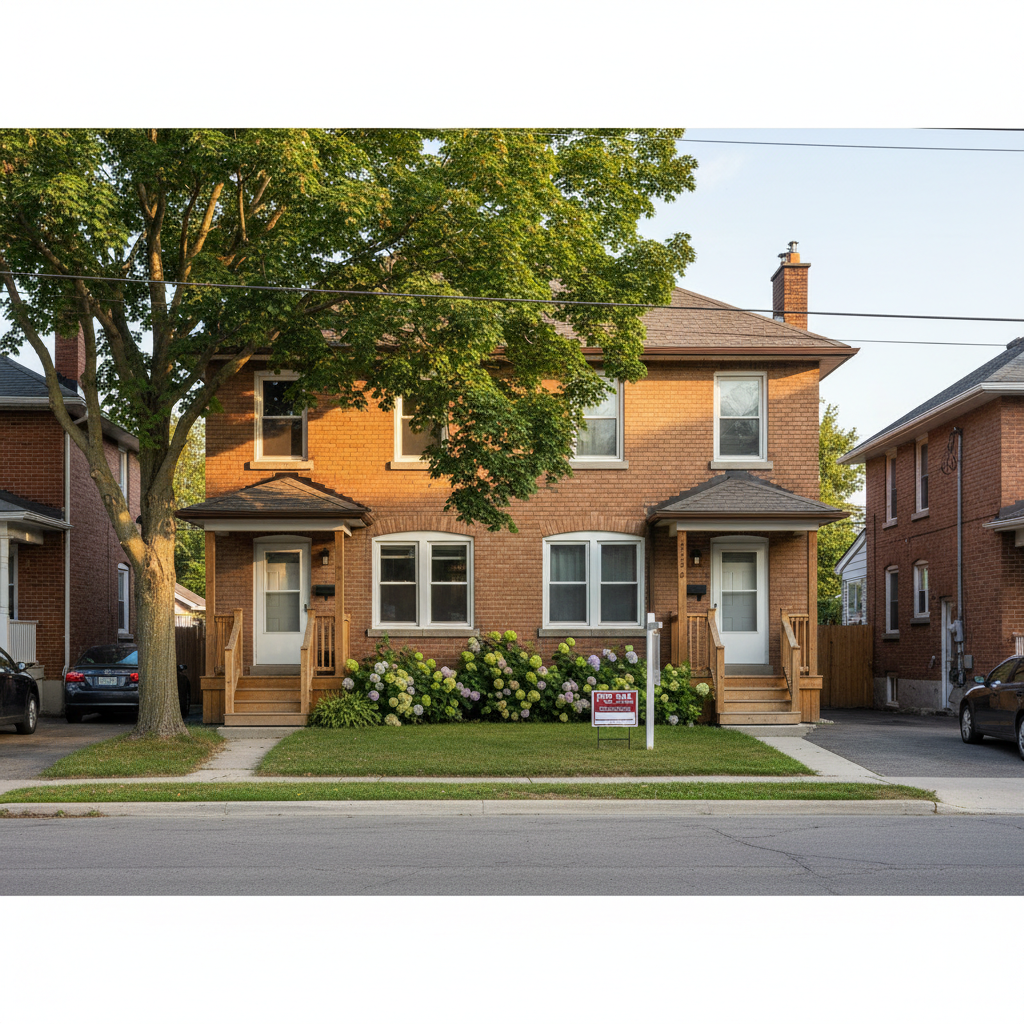
Yes. In St. Catharines, an up-and-down duplex (one home stacked on top of another) has a middle asking price of $499,000, or $249,500 for each unit, across the last 12 months of listings in our St. Catharines duplex, triplex and fourplex asking-price report. That price sits just under $500,000. So a family that will live in one unit needs 5% down, which is $24,950, and the bank can count the rent from the other unit when it works out what you can afford.
The wider market is helping too. In October 2026, the average St. Catharines detached, semi or townhouse sold for $503,531, down 16% from a year earlier, with 782 homes for sale, according to our St. Catharines market report for October 2026. Prices that drop and plenty of choice are a good mix for a family buying its first home.
I'm Regina Marin-Suarez. I live in Grimsby, I was born in Mexico City, and I've worked in real estate since I was nineteen. Most of the families I sit down with, many of them in Spanish, start by telling me what a cousin or a coworker said they need to buy. The number they repeat is usually 20%. For a duplex you live in, that number is wrong, and it keeps good families renting for years longer than they have to. You can read more about how I work with first-time buyers and newcomers.
What St. Catharines duplexes and triplexes ask per unit
"Per unit" means the price split by the number of homes in the building. It's the fairest way to compare a duplex with a triplex. Our report shows the middle asking price (half the listings asked more, half asked less) for each building size over 12 months:
| Building | Middle asking price | Per unit | Listings in 12 months |
|---|---|---|---|
| Duplex, side by side | $419,000 | $209,500 | 4 |
| Duplex, up and down | $499,000 | $249,500 | 12 |
| Triplex | $644,450 | $214,817 | 11 |
| Fourplex | $899,900 | $224,975 | 4 |
Two things jump out at me.
First, the side-by-side duplex looks like a bargain at $80,000 less than the up-and-down kind, but only 4 of them listed in a whole year, so that middle price could swing a lot with one or two new listings, and I wouldn't plan a family's savings around a number built on four homes. The up-and-down duplex, with 12 listings, is the one you're more likely to find.
Second, these are asking prices. They are what sellers hoped for when they listed, which is a starting point for your offer and nothing more.
What 5% down pays for, and the $500,000 line
The 5% rule has a limit. You pay 5% on the first $500,000 of the price. On any part above $500,000, you pay 10%.
At the side-by-side middle price of $419,000, 5% down is $20,950. At the up-and-down middle price of $499,000, it's $24,950. Both sit under the line, so the whole price gets the 5% rate.
Now look what happens above it. As an example with a round number, say you find a Hamilton duplex asking $700,000. You'd pay 5% of the first $500,000, which is $25,000, plus 10% of the other $200,000, which is $20,000. That's $45,000 down. Going $200,000 higher in price almost doubles the cash you need, and that one rule is the reason I push families on a 5% budget to look hard at St. Catharines, Thorold and Welland before they fall in love with a bigger city listing.
When you put less than 20% down, the bank adds a fee for mortgage insurance to your loan. That insurance protects the bank if the loan goes bad. You pay for it, spread out inside your mortgage, so it doesn't come out of your savings on day one.
What does come out of your savings is closing. The lawyer, the land transfer tax and moving all cost money on the day you get the keys. Keep a separate pile for them. The 5% is only for the down payment.
The rent from the other unit: who pays whom
This is the part that changes everything. With a two-unit home you live in, the bank can count up to 100% of the full rent from the other unit (the rent before any costs) as if it were part of your pay. More counted income means the bank will lend you more.
In the twelve months to November 17, 2026, a self-contained unit in St. Catharines (an apartment-style unit or a one- or two-bedroom inside a house) had a middle asking rent of $1,700 a month, and those units took 7 days to lease, at the middle. That's $20,400 a year of rent the bank can look at. In Hamilton, the same kind of unit asked $1,795 a month and took 15 days. These come from lease listings on both local boards, so they're asking rents, not signed leases.
Who pays whom matters as much as the rent. Your tenant pays you. You pay the mortgage, the property tax and the insurance. Hydro, gas and water depend on how the house is set up.
On a duplex showing, the first thing I look for is the meters. If there are two hydro meters, the tenant usually pays their own hydro. If there's one, you're paying it for both units, and that money comes out of the $1,700 before it ever reaches your mortgage. I'd rather find that out in the basement on a Saturday than on the first bill.
Picture a family of four from Bogotá renting a two-bedroom apartment in St. Catharines. A cousin told them they need 20% down, which on a $500,000 home, as a round example, is $100,000, and they are nowhere close. They keep saving and keep paying rent. Then they learn that a duplex they live in needs 5%, about $25,000 at that price, and that the bank counts the rent from the other unit. They stop looking at the cheapest small houses and start looking at up-and-down duplexes. The rent they used to send to a landlord turns into rent a tenant sends to them.
Why I tell most 5% families to skip the triplex for now
This is the opinion some investors will argue with me about. Look at the table again. A triplex costs less per unit than an up-and-down duplex: $214,817 against $249,500, a gap of $34,683 per unit. On paper, the triplex wins.
For a family with 5% saved, it loses. Three- and four-unit homes need at least 10% down, even when you live in one of the units. At the triplex middle price of $644,450, that's $64,445. Compared with $24,950 for the up-and-down duplex, you need quite a bit more cash to get in the door, roughly $39,500 more at these two middle prices. A fourplex at $899,900 needs $89,990.
The rent help is smaller too. With three or four units, the bank counts only up to 50% of the full rent (or the rent after costs), so each tenant's cheque helps you less on paper than the one tenant in a duplex.
So my advice is plain. If 5% is what you have, buy the duplex. Live in it, keep the tenant happy, and let the home grow in value while you pay down the loan. A triplex can be your second move, and many families make it.
A Hamilton duplex: what I check before comparing it with Niagara
Hamilton has more choice and a bigger rental market, and the asking rent for a self-contained unit there is $95 a month higher than in St. Catharines. That gap is worth something.
I don't have a Hamilton per-unit duplex number in this post. The place to check it is our Hamilton duplex report, which shows the middle asking price per unit by building size and by neighbourhood. Before I compare a Hamilton duplex with one in St. Catharines, I look at three things there:
- Whether the asking price crosses $500,000, because that's where the 10% part starts.
- How many listings the per-unit number is built on, since a thin sample can mislead.
- Which neighbourhood the listing sits in, because per-unit prices change a lot from street to street.
If you'd like to see the kinds of buildings families are using this way, our Hamilton investment properties page is where we gather them. A Hamilton duplex that lands under $500,000 with two meters and a separate entrance is one of the best first homes in this region. One that lands at $650,000 may still work, but you'll need more saved.
What the bank asks a newcomer for
This is where newcomers get stuck, and it's rarely the down payment. The bank wants to see that you earn steady money here and that you pay your bills on time here.
Expect to be asked for a letter from your employer with your job, pay and start date, plus recent pay stubs. If you work for yourself, the bank wants tax papers from Canada, and that usually takes longer to build up.
Your credit score matters, and many newcomers have a short history. A Canadian credit card, used a little and paid in full every month, is the slow and steady way to build one. The bank also wants to see where your down payment came from, so don't move money around between accounts in the months before you buy. Every move is one more thing someone will ask you to explain.
I'd start talking to a bank before you start looking at listings. A free check on where you stand tells you your real budget, and with a duplex, it tells you how much that rent from the other unit helps.
Questions people ask
Can my family in Mexico or South America give me the down payment?
In most cases, yes, if they're close family. The bank will ask for a signed gift letter that says the money is a gift and does not have to be paid back. It will also want to see the money arrive in your Canadian account, so send it early and keep every bank record.
Do I have to live in the duplex to put only 5% down?
Yes. The 5% rule is for a home you will live in. If you buy a duplex only to rent out both units, the bank will usually ask for at least 20% down. Living in one unit is what opens the smaller down payment.
Will a St. Catharines duplex sell for its asking price?
Not always. In October 2026, homes in St. Catharines took 41 days to sell on average, according to our October report, which gives buyers time to look and room to talk about price. The asking prices in this post are where the talk starts.
Talk to me about your duplex budget
If you have 5% saved, or you're close, the next step is a short call with me. I'll go over your numbers in Spanish or English, and we'll see whether an up-and-down duplex fits your family. Book a call with our team.
En español
Sí, una familia puede comprar un dúplex en St. Catharines con 5% de enganche si va a vivir en una de las unidades. En los últimos 12 meses, el precio de lista medio de un dúplex de arriba y abajo fue de $499,000, así que el 5% son $24,950. El banco puede contar la renta de la otra unidad como parte de sus ingresos, y eso le ayuda a calificar para una hipoteca más grande. Yo trabajo con familias en español en Hamilton, Grimsby y Niagara, y con gusto reviso sus números con ustedes. Reserve una llamada con nuestro equipo.