
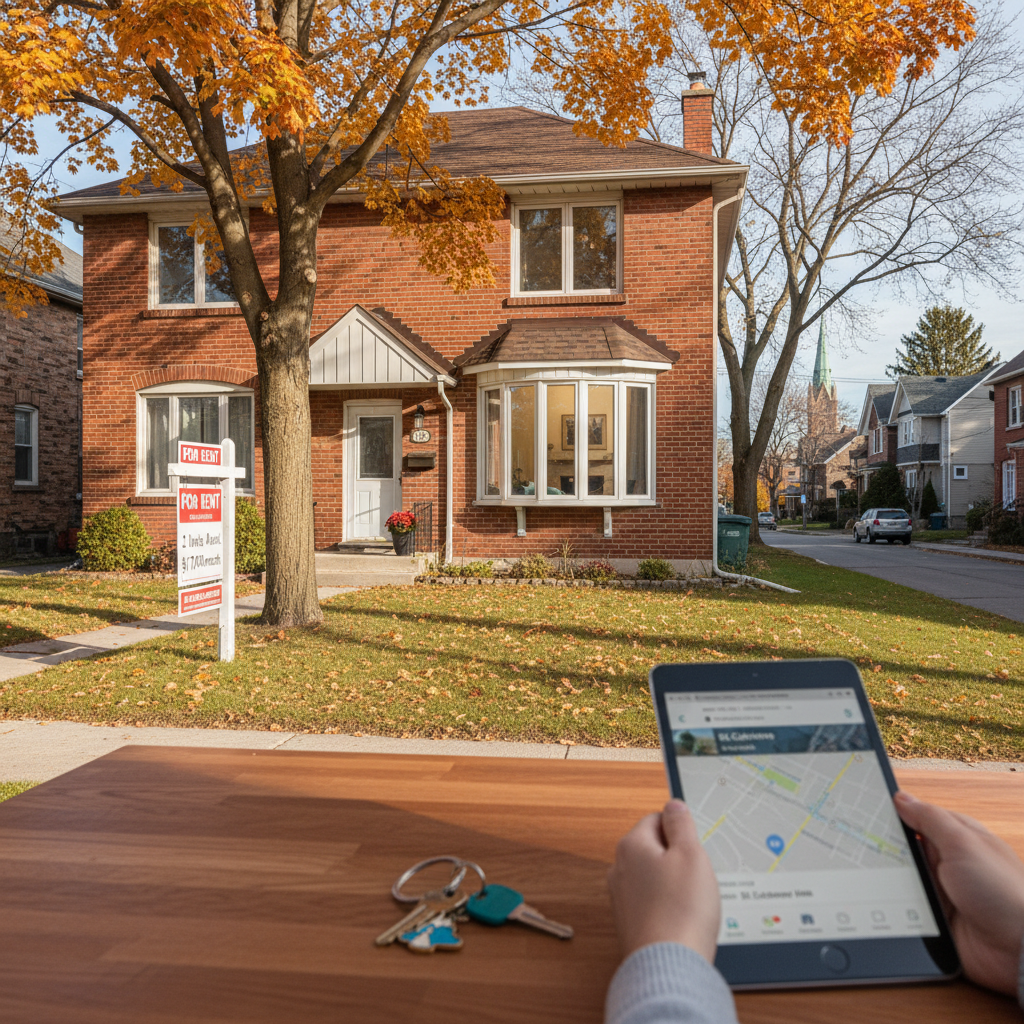
Check the rent a listing promises against lease listings for the same kind of unit nearby, then against what the bank will count. Over the twelve months to November 13, 2026, a self-contained unit in St. Catharines (an apartment with its own kitchen and bathroom) asked a median of $1,700 a month. In Welland the same kind of unit asked $1,500.
If a listing says the basement will bring in a lot more than that, you need a reason before you build your budget around it. Those are asking rents from lease listings on both local boards, so treat them as a ceiling. Signed leases can come in lower.
I bought my first home this way. I house hacked my own first place in St. Catharines, a house with a unit I could rent, and the rent is what made the mortgage possible. I still live here. So I read rent numbers on listings like someone whose own budget once depended on them.
Why the rent on the listing and the rent you'll get drift apart
The rent on a listing is the seller's best guess at good news. It's written to sell the house.
Sometimes it's fair. Often it's the top of the range, or the rent a unit could get after new floors, or a number for a unit that's empty right now, which means nobody is paying it yet. Sometimes it's the opposite: a long-time tenant paying far below today's rents, and the listing quotes what the unit "should" get.
There's a bigger trap too. If the unit isn't one the city has approved, the bank may not count its rent at all, and a unit that isn't legal can be hard to insure and harder to defend if anything goes wrong with a tenant, so a listing rent on an unapproved unit is worth very little to you on day one.
Picture a young couple who find an up-and-down duplex in St. Catharines with a listing that says the lower unit rents for about $2,000 a month (a round example). They set their whole budget around that number. Then they look at lease listings for similar units nearby and see most asking closer to $1,700, with a few higher ones sitting unrented for weeks. They redo the math with the lower rent, see they can still make it work, and offer a little less. The deal holds up because the plan never needed the hopeful number.
That's the whole point of this post. Build your plan on the rent you can prove, and let any extra be a bonus.
Price the unit from both boards, one unit at a time
Niagara rentals get listed on more than one local real estate board. If you only look at one, you see half the picture. I price every unit from both boards, and I match like with like: a two-bedroom lower unit gets compared to two-bedroom lower units, not to whole houses.
Here's what the medians looked like over the twelve months to mid-November 2026:
- St. Catharines: self-contained unit $1,700, leased in a median of 7 days. Three-bedroom-plus house $2,300, leased in 8 days.
- Welland: self-contained unit $1,500, leased in a median of 29 days. Three-bedroom-plus house $2,300, leased in 19 days.
Look at the days-to-lease number as hard as the rent. A unit that rents in a week and a unit that sits for a month are two different businesses.
The rent gap between the two towns for a self-contained unit is $200 a month, which is $2,400 over a year. That matters. But Welland's longer wait to lease matters too, because every empty week is a week you cover the whole mortgage yourself.
One more Welland detail I watch: a condo apartment there asked a median of $1,635 and leased in 7 days. That's your competition. A renter looking at your lower unit in Welland may also be looking at a condo for about the same money, so your unit has to give them a reason, like parking, a yard or laundry.
What I do in practice: I pull the active and recently rented listings for that exact street area, note the ones that leased fast and the ones that sat, and use the fast ones to set my number. If the listing rent is above everything that leased quickly, I use the lower number in the math. Every time.
The bank does its own rent math, and it decides what you can afford
Your rent estimate and the bank's are two separate numbers. The bank's is the one that counts for the mortgage.
Under CMHC rules (CMHC is the federal housing agency that insures most low down payment mortgages), the size of the building changes how much rent the bank will count:
- Two units: the down payment can be the same as a regular house, 5% on the first $500,000. Up to 100% of the total rent before costs from the other unit can count toward what you can afford.
- Three or four units: you need at least 10% down. Up to 50% of the total rent can count, or the rent after costs.
So say a triplex has two rented units bringing in $3,000 a month together (a round example). The bank might count only $1,500 of it. If you planned on the full $3,000 to make the payments work, the gap shows up the day you apply.
Now put prices beside that. In the St. Catharines multiplex report, median asking prices over twelve months were $499,000 for an up-and-down duplex ($249,500 per unit) and $649,000 for a triplex ($216,333 per unit). In the Welland multiplex report, a triplex asked $692,000 and a fourplex $724,450, which works out to $181,113 per unit, the lowest per-unit figure across both towns. Those are asking prices, not sale prices.
A lower price per unit looks great. But with three or four units the bank counts less of the rent, so the cheapest building per door isn't always the one you can afford to buy. I run the bank's rent math before any offer, using the lower of the listing rent and the rent I can prove from both boards. We lay out the full method in how we work out the numbers on a rental.
And the city comes first. Before I trust any rent, I check the unit's legal status with that city. Rules differ in St. Catharines, Welland, Niagara Falls, Thorold, Port Colborne and Fort Erie, so I ask the town the property is in. A seller saying "it's legal" is not the same as the city saying it.
Students near Brock and Niagara College: strong demand, different math
The buyers I sit down with near Brock University and Niagara College usually ask the same thing first: can I rent by the room and make more?
Student demand around both schools is real, and it's a big reason house hacking works in this corner of Niagara. But a listing that adds up five bedrooms at room rates is quoting the best case. Our rent data doesn't break out by-the-room rents, so I won't hand you a number for it. Here's what I watch instead:
- How fast nearby rooms and units lease. Quick turnover near campus tells you more than any single asking price.
- The school year. Student leases tend to line up with the school calendar, and a room that empties in spring can sit until fall.
- The town's rules. Some Niagara towns have rules about rentals near campus, and they can limit how many renters share one house. I check with the city before counting a single room.
The bank also tends to look at the unit, not the room. If your plan only works at room rates, test it at the plain unit rent first. If it still works, the rooms are upside.
What I'd do this month before writing an offer
The market gives you room to check. In October 2026, St. Catharines had 783 homes for sale and homes took 42 days to sell on average, per the St. Catharines market report. The average freehold price was $503,821, down 16% from a year earlier. Welland homes averaged 55 days on market in October 2026 with 493 for sale, per the Welland market report. When homes sit that long, you usually have time to ask questions before you sign.
So here's my list:
- Ask for the current leases in writing. Plus proof the rent gets paid, like bank deposits. A rent with no lease behind it is a guess.
- Price the unit from both boards. Same unit type, same part of town. Use the ones that leased fast.
- Call the city about the unit. Ask if it's an approved unit. Get the answer before you count the rent.
- Run the bank's math at the lower rent. Two units, up to 100% of rent counts. Three or four, up to 50%.
- Plan for empty weeks. Use the days-to-lease numbers above. In Welland, plan for a longer wait than in St. Catharines.
One buyer, Fabiola, said in a review that I "prepared an evaluation sheet for me to fill out for each property." That sheet is the list above. It makes every house answer the same questions, so the listing rent can't talk you into anything.
If you want the whole process in one place, start with our house hack starter kit. It covers the down payment, the bank's rent rules and the steps from first showing to first tenant. You can also compare towns in our market reports for all 26 areas.
My take: never let a listing's rent be the reason a house works for you. If the numbers hold up at the rent you can prove, buy it. If they only work at the seller's number, walk.
Questions people ask
Can I raise the current tenant's rent to market rent after I buy?
Usually not right away. In Ontario, a sitting tenant's rent can generally go up only once every 12 months, and for most older units by no more than the yearly provincial limit. Units first lived in after November 15, 2018 follow different rules. That's why a below-market tenant is part of the price you pay, and your math should use the rent they pay today.
What do townhouses rent for in St. Catharines and Welland?
Over the twelve months to mid-November 2026, townhouses in St. Catharines asked a median of $2,400 a month and leased in 7 days. In Welland they asked $2,300 and leased in 14 days. That's useful if you're buying a townhouse with a unit, or comparing what a family would pay for your upper unit against a whole townhouse.
Are Niagara Falls homes cheaper than St. Catharines homes right now?
No. In October 2026 the average freehold price in Niagara Falls was $625,309, up 3% from a year earlier, per the Niagara Falls market report. That's $121,488 above St. Catharines' $503,821. Our data doesn't have Niagara Falls rent medians, so there I price each unit from lease listings one by one, and I keep an eye on the South Niagara hospital due in 2028.
Check the rent before you count on it
Send me the listing you're looking at, and I'll price the unit from both boards and run the bank's rent math on it with you. Send me the listing here and I'll reach out to talk it through.