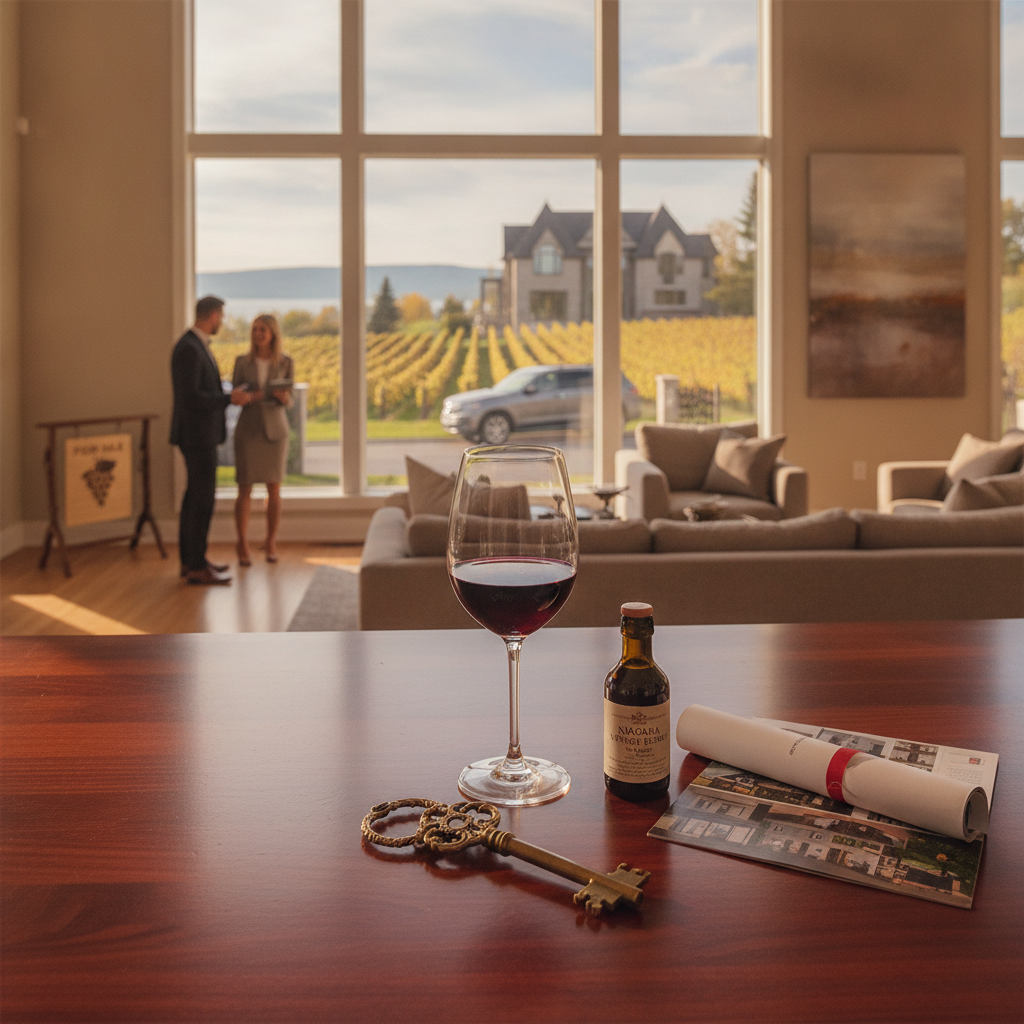
Buyers from Europe and Asia are calling about Niagara wineries because the region offers something rare: a recognized VQA wine appellation close to a major international airport, inside a stable property market that's actually showing momentum. In Niagara-on-the-Lake, home sales rose 47% year over year in August 2026 to 69 sales, with the average freehold sale price up 6% to $898,750. For overseas buyers watching currency and market strength together, that kind of activity signals a region worth taking seriously, not a niche curiosity.
An inquiry came in last week about a Niagara winery. It didn't come from Toronto, or even from Canada. It came from Europe, from someone who had never set foot in the Niagara Peninsula but had clearly done their homework on the region.
That's not a one-off. Over the past few weeks we've seen a real uptick in interest from buyers overseas, mostly out of Europe and Asia, exploring what it would actually look like to own a piece of Canada's wine country. Some want to run a working winery. Others want to take over one that's already built and just needs new ownership. A few just want to understand the numbers before they commit to anything.
Here's what's driving that interest, what these buyers are really asking, and what it means if you happen to own a vineyard or winery property in the region right now.
Why Niagara, Specifically
Niagara isn't just a pretty stretch of escarpment. It's a formally recognized wine appellation under the VQA system, with its own microclimate created by the Niagara Escarpment and the moderating effect of Lake Ontario. That combination is rare. It lets the region grow grape varieties that struggle almost everywhere else in Canada.
For a European buyer who's spent years around established wine regions, that story is easy to understand. What's harder to find in most of the world is a wine region this close to a major international airport, a few hours from a border crossing into the United States, and inside a country with stable property rights and a currency that, for a lot of foreign buyers right now, stretches further than it used to.
Add it up and Niagara reads less like a niche curiosity and more like an accessible entry point into wine country ownership. That's the pitch these buyers are hearing, and it's a fair one.
What These Buyers Are Actually Asking
The questions coming in aren't about grape varietals or tasting notes. They're practical, and they're the same handful every time.
First, can a non-resident actually buy property here. Yes, but it's worth knowing that Ontario applies a 25 percent Non-Resident Speculation Tax on most residential purchases by foreign buyers. Winery properties often carry a mixed residential and agricultural designation, so this is one of the first things we walk through with any international buyer before they get attached to a specific property.
Second, can they get financing from a Canadian lender without Canadian credit history or income. This is usually the sticking point. Most Canadian banks want to see local income, local credit, and often a larger down payment from a non-resident borrower. Some buyers plan to pay cash. Others need a lender who specializes in non-resident files, and that's a smaller list than people expect.
Third, and this one surprises people, they ask about the liquor licence. A winery's value isn't just the land and the buildings. It's tied to production licensing, distribution agreements, and sometimes a retail store licence on site. None of that transfers automatically just because the land changes hands. It needs its own due diligence, separate from the real estate transaction.
Buying a Working Winery Is Not Like Buying a House
This is the part that catches first-time winery buyers off guard, foreign or domestic. A house closes, you get the keys, done. A winery is a business wrapped inside a real estate transaction, and the two have to be underwritten separately.
You're not just buying acreage. You're buying an existing vine inventory that took years to mature, equipment that may or may not be included, an agricultural assessment status that affects your property tax bill, and in many cases, staff who know the vineyard better than any new owner will for the first few seasons. Walk away from any of that too quickly and the winery you bought stops performing the way the one you visited on your first tour did.
For buyers coming from overseas, this usually means a longer diligence period than a typical residential deal. It's common to bring in an agronomist to assess vine health, a separate accountant to review three to five years of production and sales history, and legal counsel who understands both real estate law and Ontario's liquor licensing framework. None of that is a red flag. It's just what a serious winery purchase actually looks like once you get past the listing photos.
The Off-Market Reality in Niagara
Right now there are three winery opportunities we're actively working through with interested buyers. One of them is listed publicly. The other two are off-market, meaning they aren't sitting on Realtor.ca or anywhere else a casual search would turn them up.
That's typical in this niche. Winery owners are often reluctant to publicly list, because a public listing tells competitors, suppliers, and sometimes staff that the business is for sale before the owner is ready for that conversation. So the real inventory of what's actually available in Niagara is always larger than what shows up in a public search.
This is exactly why working with someone who has relationships across the region matters more here than in almost any other property type we deal with. A buyer searching public listings alone is seeing a fraction of the actual opportunity. If you want a sense of what's currently available, both public and through private conversations, our Niagara properties page is the best starting point, and from there a real conversation usually uncovers more than the listings themselves show.
What This Means If You Own a Winery or Vineyard Property
If you own a winery or a vineyard property in Niagara and you've been sitting on the idea of selling, this uptick in international interest is worth paying attention to. Foreign buyers bringing currency advantages and a genuine appetite for an established Canadian wine business are exactly the kind of demand that can move a niche property faster than the general market would suggest.
The catch is that these buyers are doing serious homework before they make an offer. They want clean production records, a clear picture of the licensing situation, and an honest read on where the vines actually stand. Owners who get ahead of that, rather than scrambling to assemble it after an offer comes in, tend to have a much smoother process and a stronger negotiating position.
If you're even loosely curious what a property like yours might be worth in today's market, starting with an instant home evaluation gives you a real baseline before you have any conversation about listing, publicly or off-market.
A Regional Market That Keeps Proving Itself
This international interest in wineries isn't happening in isolation. It's landing during a stretch where activity across Burlington, Hamilton and Niagara has stayed more active than a typical August, and where the region keeps drawing attention for different reasons at different price points. Premium Burlington neighbourhoods are pulling strong interest right now, small multifamily properties keep giving first-time buyers a smart entry point, and now wineries are pulling in buyers from the other side of the planet. It's a reminder that this region has more than one story to tell, and each one is worth understanding on its own terms.
We've written before about some of these patterns, including how two first-time buyers used secondary suites to get into the market smartly, and what it looked like when an offer got presented face to face in Burlington instead of over email. Different property types, same underlying lesson: the details matter, and knowing the region well enough to spot the right opportunity is what makes the difference.
The takeaway is simple. Niagara's wine country is drawing serious international attention right now, but buying or selling a working winery takes a different kind of diligence than a typical home sale, and most of the real opportunity in this niche never shows up in a public search.
Let's Talk About What You're Trying to Do
Whether you're curious about owning a piece of Niagara wine country, thinking about what your own winery or vineyard property might be worth, or just trying to make sense of where this market is headed next, a real conversation beats guessing. You can read more of our take on the local market on the Found Spaces blog, learn more about who's behind these insights on Sandy MacKay's page, or simply reach out and book a call to talk through what you're seeing and what it might mean for you.