
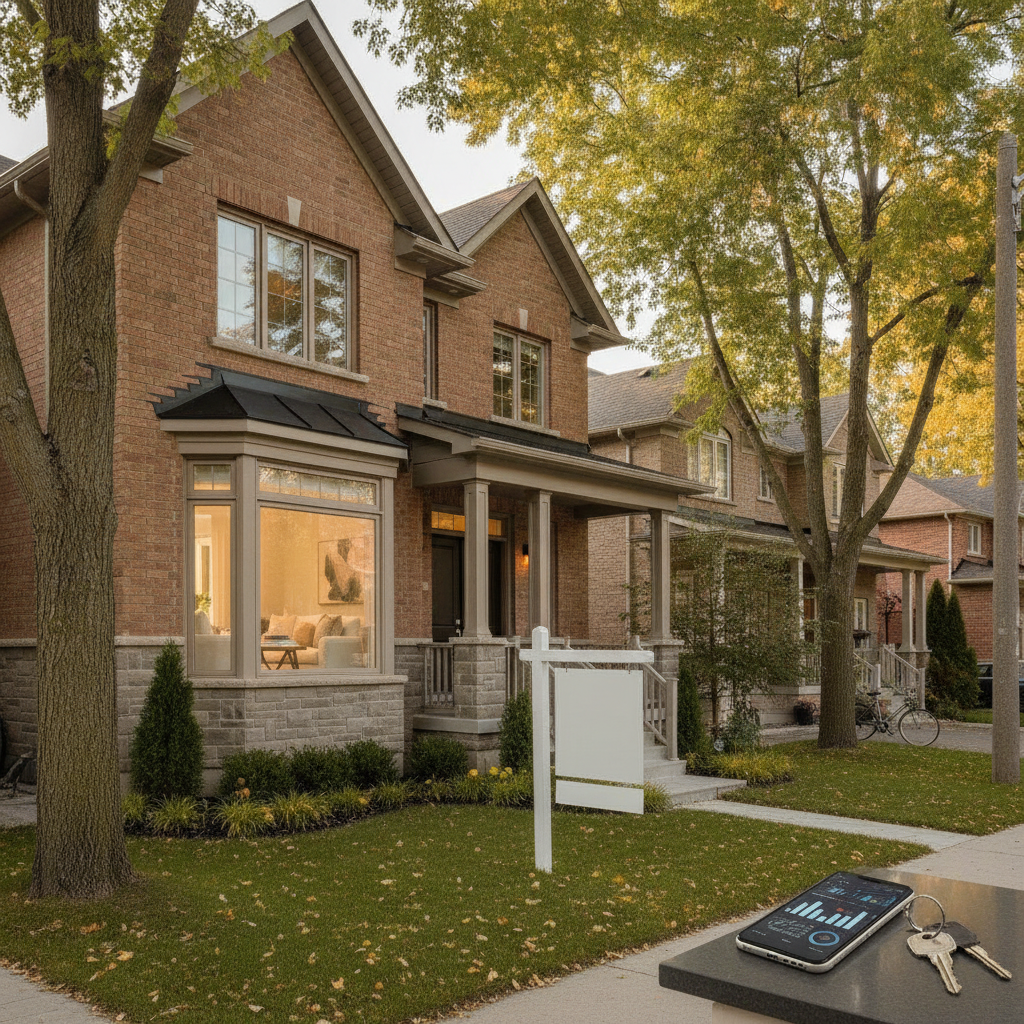
Burlington's data doesn't point to a crash or a boom. The most recent Cornerstone numbers show 222 home sales in August 2026 (up 1% from a year earlier) against an average freehold sale price of $1,145,039, down 6% from a year earlier, with homes taking 36 days on market on average, according to the Burlington market report. That's a market cooling on price while still moving at a steady pace, not one flipping sharply in either direction.
A homeowner on Guelph Line asked us last week if she should list now or wait until spring. Fair question. Everyone wants a number. A percentage. A date. The honest answer is that nobody can hand you a single figure and call it a prediction. But we can walk through what Cornerstone and CREA data is actually showing right now, and what tends to move Burlington specifically. That gets you a lot closer to a real answer than any headline will.
Where Burlington sits today, not where it was in 2022
Burlington is still catching its breath from the run-up years. Cornerstone Association of REALTORS, the board the Realtors Association of Hamilton-Burlington became in 2024 tracks this market monthly, and the pattern over the past couple of years has been steadier than people expect. Sales have moved in fits and starts tied almost entirely to interest rate news, not to anything unique happening in the city itself. When the Bank of Canada signals a cut, showings pick up within weeks. When it holds, buyers go quiet again.
That matters for predictions. Burlington's market right now is less about local supply shocks and more about national monetary policy filtering down to a specific postal code. If you're trying to predict Burlington, you're really trying to predict the Bank of Canada, immigration policy, and how much appetite Toronto move-up buyers still have for the drive west on the QEW.
We covered the most recent CREA numbers and what they mean for this region in more detail in our breakdown of Ontario's shift out of a buyers' market, and the same forces are still in play here.
The rate story everyone is watching
The Bank of Canada has trimmed its overnight rate several times since mid-2024, and that has slowly pulled some buyers off the sidelines. But lower rates don't flip a switch overnight. Mortgage renewals are the real mechanism to watch. A big wave of Burlington homeowners locked in ultra-low rates back in 2020 and 2021, and many of them are renewing now at higher payments than they budgeted for. Some of those homeowners will sell rather than absorb the shock. That's a quiet source of new listings that doesn't show up in headlines but shows up in Cornerstone's monthly inventory count.
The practical prediction here isn't a price target. It's this: expect gradual buyer confidence to return as rates ease, matched by a gradual trickle of sellers forced into the market by renewal shock. That tends to keep things balanced rather than triggering a sudden price jump in either direction.
Supply is the part people forget to ask about
Everyone asks about demand. Fewer people ask what's actually available to buy, and that's the half of the equation that decides whether prices climb or stall. Burlington has limited land left for new freehold subdivisions. Most new supply coming online is mid-rise and high-rise condo product, concentrated around the downtown core and the GO station corridor.
That split matters for predictions. Freehold detached homes in established Burlington neighbourhoods, the kind near Nelson Park or up in the Alton Village area, face structurally tight supply. New construction isn't replacing that stock. Condos are a different story. Several projects delivered or delivering over the next couple of years mean condo buyers actually have more choice and more negotiating room than they did a few years back. If you're watching for a prediction split, that's the real one: freehold and condo in Burlington are not moving together right now, and treating them as one market will mislead you.
Why Burlington doesn't move on its own
Burlington's fate is tied to Hamilton and to Toronto in ways that are easy to miss if you only watch local listings. GO Transit service along the Lakeshore West line means a meaningful chunk of Burlington buyers are Toronto commuters priced out of the city, chasing more house for the money. When Toronto's market tightens, Burlington usually feels a lagged bump a few months later as those buyers widen their search radius.
Hamilton pulls a similar role for Burlington's own priced-out buyers. Someone who can't quite make Burlington work often lands in Hamilton's Mountain or east end, and that flow keeps both markets loosely connected. We've written before about how the best neighbourhoods tend to move first once confidence returns, and Burlington is usually one of the earlier movers in this corridor because of that commuter demand.
Niagara plays a different role entirely. It draws retirees, remote workers, and lifestyle buyers rather than commuters, so it tends to respond to different triggers, like retirement timing and wine country tourism interest, more than it responds to Toronto's rate cycle. If you're weighing a move toward vineyard country, browsing current Niagara listings will tell you more about local pace than any regional forecast will.
What a smart buyer does with this information
If you're waiting for a headline that says "prices will drop 8 percent" or "prices will rise 5 percent," you'll be waiting a long time, because nobody credible publishes numbers that precise for a city-level market. What you can do instead is act on the structural pieces that are actually knowable.
Freehold Burlington homes in tight-supply neighbourhoods are unlikely to get materially cheaper while land stays scarce. If you're set on a detached home here, waiting for a discount is a riskier bet than negotiating hard on a specific property today. Condos are the opposite story. With more inventory landing, buyers willing to be patient through this fall and winter have real leverage on price and closing terms.
One more thing worth knowing: purchase plus improvements financing lets some buyers stretch into a home that needs work rather than competing for move-in-ready stock in the tightest segment. It's underused and it changes the math on what's actually available to you.
What a smart seller does with this information
Sellers often ask us to just tell them where prices are headed so they can time it perfectly. The better question is whether your specific home fits into tight supply or loose supply. A well-kept detached home in a mature Burlington neighbourhood is competing in a genuinely tight lane, and that gives you real pricing confidence even in a mixed overall market.
If you own a condo, the calculation is different. More competing inventory means presentation and pricing accuracy matter more than they did two years ago. An overpriced condo sits. A correctly priced one still moves, because buyer demand hasn't disappeared, it's just gotten pickier. We wrote a full piece on getting this right if your property falls into a harder-to-sell category, in our guide to pricing a tough-sell home this fall.
Either way, the starting point is the same: know what your specific home is actually worth today, not what a national headline implies it's worth. A proper instant home evaluation gives you a real, current number based on this market, not a guess based on a forecast written for the whole country.
The prediction nobody wants to hear
Here's the honest version. Burlington is unlikely to see a dramatic crash or a dramatic boom over the next year. The structural tightness in freehold supply puts a floor under detached home values. The wave of condo completions and the mortgage renewal cliff put a ceiling on how fast things can heat up. That middle ground isn't exciting, but it's real, and it's a far more useful prediction than a made-up percentage.
The teams and individuals who do well in a market like this aren't the ones who guessed the top or the bottom. They're the ones who understood their own property, their own timeline, and the specific segment they're buying or selling into. That's the work worth doing instead of chasing a forecast.
The real prediction for Burlington isn't a number, it's a shape: tight freehold supply holding values steady, looser condo supply giving buyers leverage, and both segments swinging with the Bank of Canada more than with anything happening on the ground here.
Talk it through with someone who watches this daily
Forecasts are useful background noise. What actually helps you make a good decision is a plain conversation about your specific street, your specific property type, and your specific timeline. Sandy MacKay and the Found Spaces team track Cornerstone and Niagara board data every month, not just when a headline forces the question. Get in touch and let's talk through what this market actually means for you, or browse current listings across Burlington, Hamilton and Niagara to see what the tight and loose segments look like right now.