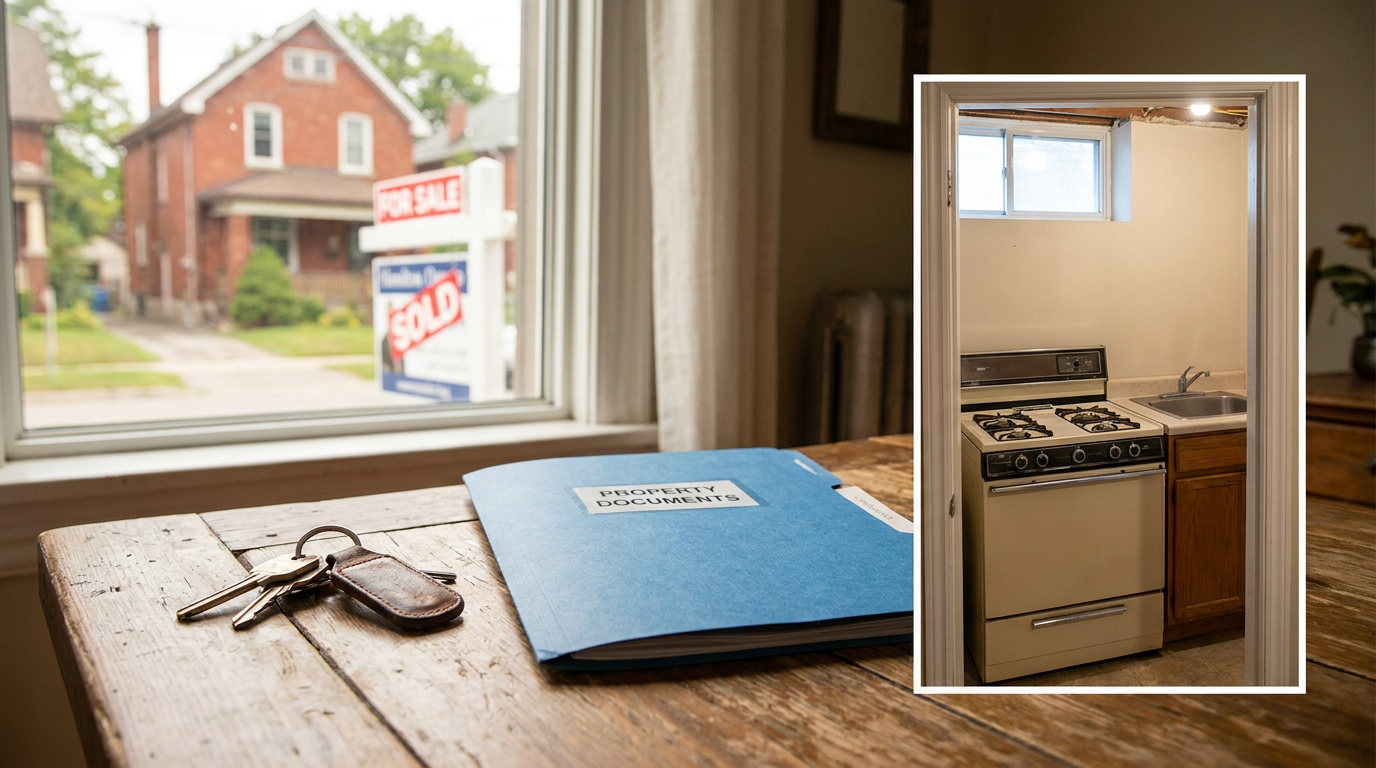
A second unit in Hamilton is legal only when the City issued a building permit for it and the work passed final inspection. A listing that says "duplex," a separate door or a kitchen in the basement doesn't prove anything. This matters because the units are priced as if they're real. A median up-and-down duplex is asking $749,900 in Hamilton, across 112 listings in the past 12 months, according to our Hamilton duplex, triplex and fourplex report.
So before you fall for the house, ask one question: where's the permit? If nobody can show you one, treat the basement as a basement until you learn more.
I'm Steve LoPresti. I'm a Realtor with Found Spaces, and I live in Ancaster. Most of the buyers I sit down with across Hamilton, Dundas, the Mountain and Stoney Creek want the same thing. They want a home where rent from a second unit helps pay the mortgage. It's a great plan. But it only works when the unit is real. Here's how I tell the difference.
Why the word "duplex" on a listing means less than you think
The word "duplex" on a listing is a description. It's the seller's word, or their agent's. Nobody checks it before it goes up.
The tax bill has the same problem. A property can be assessed as two units because two households live there. That tells you how the house is being used. It doesn't tell you whether anyone inspected it.
I'll say something some agents won't like. A lot of Hamilton "duplexes" are single-family houses with a tenant downstairs. Some are well built and safe, just never permitted. Some are a stove, a bar fridge and a bedroom with a tiny window. From the listing photos, you often can't tell which is which.
The prices make this a bigger deal than it sounds. Our September 2026 Hamilton market report shows the average freehold sale price at $659,721, down 10% from a year earlier. A median up-and-down duplex asking $749,900 sits well above that. Part of that gap is the promise of rent. If the second unit isn't legal, you may be paying extra for income you can't count on.
What the lender counts, and why legal matters most here
This is where buyers get caught. They run their numbers with the rent included. Then the lender doesn't count it.
The CMHC rules make legal units powerful for a first-time buyer. On a two-unit home, the minimum down payment is the same as on a regular house: 5% on the first $500,000. Up to 100% of the gross rent can count toward qualifying. On a three- or four-unit home, you need at least 10% down, and up to 50% of the gross rent (or the net rent) can count.
Many lenders and appraisers won't give you credit for rent from a unit that isn't legal. Here's what that can mean. A self-contained unit in a Hamilton house has a median asking rent of $1,800 a month, based on our lease listing data for the twelve months to October 14, 2026. That's $21,600 a year. If the lender ignores it, your income looks $21,600 smaller on paper. For a lot of first-time buyers, that's the gap between being approved and not.
Want to see how a full deal gets tested? Our underwriting standard walks through how we check rent, costs and debt coverage on a Hamilton multiplex.
My rule: if the rent is the reason you can afford the house, the unit has to be legal, or you need a real plan to make it legal.
Picture the version that goes wrong
Picture a couple touring a bungalow on the Mountain. The basement has its own side door, a full kitchen and a bathroom. The listing calls it a duplex, and a tenant pays about $1,800 a month. They love it, so they offer with no conditions to beat another buyer. Two weeks later, their lender's appraiser marks the basement as a non-conforming unit, and the rent doesn't count. Now they're scrambling to cover a gap they never planned for. A one-page permit check before the offer would have shown them that on day one.
How I check a second unit before you make an offer
These are the steps I take on any Hamilton house sold as having a second unit. You can start most of them yourself.
1. Ask the listing agent for the permit. Ask for it in writing. You want the building permit number for the second unit and proof it passed final inspection. "It's been rented for years" isn't an answer.
2. Check with the City. The City of Hamilton's building division keeps permit records by address. You can ask what was filed and what was closed. A permit that was opened and never closed is a red flag. It can mean the work was never signed off.
3. Look for the electrical sign-off. In Ontario, electrical work is inspected by the Electrical Safety Authority. A legal unit should have that paper trail. If the basement was wired by "a guy," you'll usually see it in the panel.
4. Walk it like an inspector would. I look at a few things on every showing.
- Two ways out, or one way out that meets the rules.
- Smoke and carbon monoxide alarms in both units, connected so one sets off the other.
- A fire-rated barrier between the units, like drywall on the basement ceiling and a solid door at the stairs.
- Bedroom windows big enough to climb out of.
- Ceiling height that doesn't make you duck.
The Ontario Building Code sets the exact numbers. Your home inspector should check them. Tell them up front that you're buying it as a two-unit house.
5. Put a condition in the offer. Make the deal depend on you reviewing the permit records and getting financing that counts the rent. In a slower market, sellers are more open to this. Hamilton had 2,522 homes for sale in September 2026 and homes sat 44 days on average, per the Hamilton market report. That's room to ask for a few days to check.
An unpermitted unit isn't always a deal-killer
I don't tell people to run from every basement apartment. I tell them to price it honestly.
Ontario changed the rules in 2022. Most residential lots can now have up to three units: the main house plus two more. That opens a lot of doors in Hamilton. A unit that isn't legal today might become legal with a permit and some work.
The catch is the cost. Fire separation, a second exit, a bigger window or new wiring can add up fast. Sometimes a basement needs digging to fix the ceiling height, and that's a much bigger job. I don't have a single number for this, because every house is different. What I watch instead is how much of the work is cosmetic and how much is structural. Then I get a contractor's quote before the condition date.
If the fix is reasonable, you may be able to buy below what a fully legal duplex goes for. Compare against the side-by-side duplex median of $694,450 and the up-and-down median of $749,900 in the multiplex report. Then subtract the real cost of making it legal. That's what the house is worth to you.
If you want the bigger picture on why this path works, I'd read why Hamilton's first-time buyers are house hacking instead of renting. The team's Hamilton house hacking guide and starter kit covers duplexes, triplexes and fourplexes, along with which pockets fit which budgets.
Something you can do this month
Pick three Hamilton listings that call themselves duplexes. Email the listing agents and ask each one for the permit number for the second unit. Count how many answer with a number.
That little test will teach you more about this market than any article, mine included. It will also show you which sellers are ready to back up their price.
Questions people ask
Can I make an illegal basement apartment legal after I buy in Hamilton?
Often, yes. You apply to the City for a building permit, do the work to code, and pass inspection. Ontario's 2022 changes made extra units allowed on most residential lots. Get a contractor's quote before your conditions run out, because the price of the fix changes what the house is worth to you.
What happens to the tenant already living in the unit when I buy?
The tenant's lease stays in place when the house sells, and their rights under Ontario's Residential Tenancies Act carry over to you. You can't just ask them to leave because you're the new owner. If you or a close family member plan to move into that unit, there's a formal process through the Landlord and Tenant Board, with notice and compensation rules. Plan for that before you firm up.
Do I need to tell my insurance company about the second unit?
Yes. Tell your insurer the house has a rental unit and whether it's permitted. A policy written for a single-family home may not cover a rental. If something goes wrong in a unit the insurer didn't know about, you could have trouble with a claim. Get the insurance quote during your conditions, so you know what the policy will cost.
Let's check the house before you fall for it
Send me the listing you're looking at, and I'll tell you what I'd want to see before you write an offer. You can find me on my Found Spaces page. Or book a plain conversation with our team about buying your first Hamilton home with a second unit that really pays.