
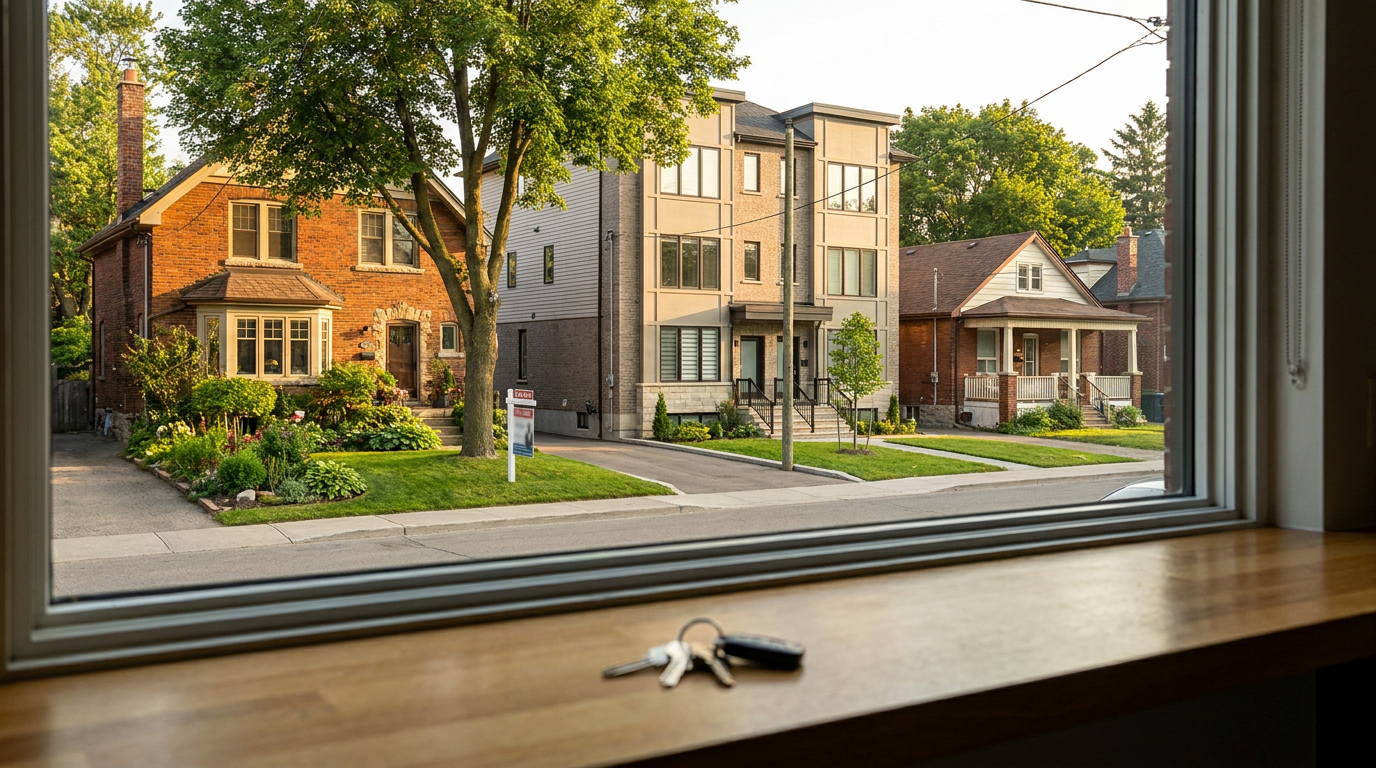
Type "average house price in Hamilton Ontario" into Google and you'll get a single number from Cornerstone Association of REALTORS, the board the Realtors Association of Hamilton-Burlington became in 2024. It updates every month. It gets quoted in every news story about the local market.
Here's the problem for investors. That number is an average of everything. It blends a $1.6 million estate in Ancaster with a $500,000 semi on the mountain and a fixer-upper triplex in the lower city. You cannot use one blended number to decide where to buy a rental property. You need to know what's inside it.
What actually goes into that number
Cornerstone's monthly average and benchmark price cover all residential sales across Hamilton, Burlington and the surrounding area, and it's usually broken down further by property type: detached, semi, townhouse, apartment/condo. But even the detached number mixes a century home in Corktown with a new build in Waterdown. The two properties have nothing in common except a roofline.
For investors, that matters because your return depends on what you're actually buying, not on the city-wide headline. A triplex on the mountain and a single detached rental in Ancaster can carry the same purchase price and produce completely different cash flow, because rent potential per dollar invested is not the same across those two properties.
Hamilton is really six or seven markets wearing one name
Lower city neighbourhoods like Crown Point, Gibson, Stipley and parts of the North End still have Hamilton's oldest housing stock, plenty of legal and semi-legal duplexes and triplexes, and generally the lowest entry price in the city. This is where most house-hacking and small multiplex buyers start.
The Hamilton Mountain is a mixed bag of postwar bungalows, mid-century semis and pockets of newer infill. Prices sit above the lower city but below the west-end and Ancaster tiers, and it's a common spot for legal basement suite conversions because lot sizes tend to be a bit more generous.
Stoney Creek and Binbrook have been absorbing a lot of Hamilton's newer detached and townhouse supply. Prices here track closer to Burlington's outer edges than to the lower city, and cash flow on a straight rental is tighter unless you're adding a secondary suite.
Ancaster and Dundas are the premium end of the Hamilton market. Detached homes here often sell well above the city average, and land value alone can make a straightforward buy-and-hold rental math difficult without a value-add angle like a coach house or a legal suite addition.
Waterdown and Flamborough sit somewhere in between, with a mix of newer subdivisions and older rural-adjacent stock, plus more flexibility around lot size for anyone thinking about future severance or accessory dwelling potential.
When a single headline average tries to describe all of that, it flattens six markets into one number that doesn't help you pick a street.
Why this trips up new investors specifically
The most common mistake we see is someone using the city-wide average as a mental anchor, then getting confused when a triplex in the lower city is priced well below that number, or when a detached bungalow on the mountain is priced well above it. Neither is wrong. They're just different products in different sub-markets.
The second mistake is comparing Hamilton's average to Toronto's average to conclude Hamilton is "cheap." That comparison ignores property type, unit count and rent potential entirely. A $700,000 fourplex generating four rent cheques is not the same asset as a $700,000 detached home generating one. If you're serious about Hamilton investment properties, the unit count and the legal status of those units matter more than where the purchase price lands relative to the city average.
A better number: price per door
Instead of asking what the average house costs, ask what the average unit costs. Take the purchase price of a duplex, triplex or fourplex and divide it by the number of legal units. That price-per-door figure is far more useful for comparing a property in Crown Point to one in Stoney Creek, because it tells you what you're paying for each stream of rent.
This is also the number that tends to hold steadier through market swings. Detached house prices can move sharply on sentiment and interest rate news. Price per door on a well-located multiplex with real rental demand tends to be a slower, steadier metric, because it's anchored to actual rent, not just to comparable sales of similar-looking houses.
We wrote about this in more detail in our earlier look at why investors should ask a different question than the headline average price. This post is the neighbourhood-level follow-up to that idea.
What zoning and secondary suite rules do to the math
Hamilton has been steadily updating its rules around secondary suites and additional dwelling units, and where a property sits can change what's legally possible on the lot. A detached home on the mountain zoned for a legal basement suite is worth more to an investor than an identical-looking house two streets over where the lot or zoning doesn't allow it. That difference will never show up in a city-wide average, but it's often the single biggest lever on your actual return.
Before you assume a house is a good value because it's priced under the average, check what the current zoning actually allows, and whether an existing basement or attic space could become a legal unit. That step alone can turn an average-looking purchase into a strong multiplex opportunity, or save you from overpaying for a house that looks cheap but can't legally do what you need it to do.
When the average price actually is useful
None of this means the Cornerstone average is meaningless. It's a good gut check on overall market direction, month over month. If the average is climbing three months in a row, that tells you buyer demand is strengthening across the board, which usually means less negotiating room. If it's flat or falling, you likely have more room to ask for price adjustments or closing flexibility.
Use the citywide average as a weather report. Use price per door, neighbourhood-level comps and zoning specifics as your actual investment tool. One tells you the season. The other tells you what to plant.
The takeaway: Hamilton's average house price is a real, useful number for tracking the market's overall temperature, but it blends together neighbourhoods and property types that behave nothing alike. Investors who want reliable cash flow should compare price per unit within a specific sub-market, check what secondary suite rules actually allow on a given lot, and treat the city-wide average as a weather report, not a shopping guide.
Talk it through before you buy or sell
If you're weighing a lower city triplex against an Ancaster detached, or trying to figure out what your current rental is actually worth in today's market, a five-minute conversation beats another hour of scrolling averages. You can book a call with our team to talk through the numbers for your specific neighbourhood and property type, and if you're already holding a rental and wondering what it would fetch, our instant home evaluation tool is a fast way to get a starting number. You can also browse current listings to see how price per door plays out across Hamilton right now.