
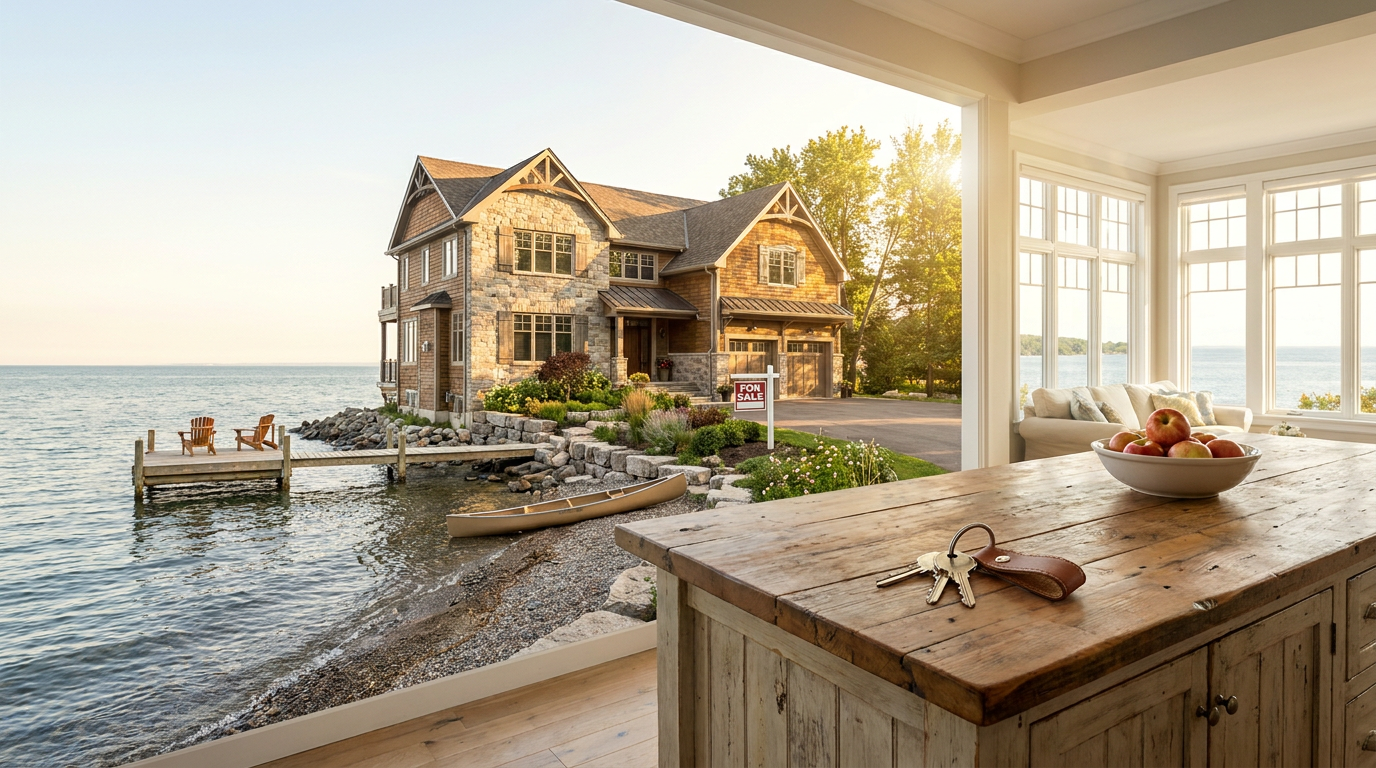
There is no honest single number for how much lake frontage adds to a Burlington home. Our own reports don't track a waterfront premium, and I haven't seen a public source that measures it well. The number I do trust is the baseline. In September 2026, the average freehold home in Burlington sold for $1,062,329, down 10% from a year earlier, according to our Burlington market report for September 2026. Every waterfront price has to be read against that number and against the houses on the same street.
Most lakefront homes sit well above that average, in the top price band. In the 52 weeks to October 17, 2026, Burlington homes asking $1.5 million and up made up 390 sales, or 15.7% of all sales. Those 390 sales came from 1,032 new listings, a sell-through of just 38%, as the Burlington $1.5M+ price band figures show. Put simply, about six in ten top-end listings did not turn into a sale in that stretch. Frontage priced on a guess is one of the ways a listing ends up in that six.
Why one percentage can't work on Burlington's shoreline
The lake is the same lake from Aldershot to the Oakville border. The lots on it are not.
A wide, level lot in Shoreacres with a solid breakwall and a lawn that runs to the water is a different product from a narrow lot on a high bank where you see the lake but can't easily get down to it, and a buyer will pay very different amounts for each, even if the two houses are the same size. A percentage hides all of that.
These are the things that move the frontage value, in my experience:
- Width of the frontage. More feet on the water usually means more privacy and a bigger view.
- Shoreline type. Low bank, high bank, or a bluff. Can you walk to the water?
- Shoreline protection. Is there a breakwall or armour stone, and what shape is it in?
- Rules on the land. Much of the shoreline sits in an area regulated by Conservation Halton. That can limit where you build, add or rebuild.
- The road side. Frontage off Lakeshore Road feels different from a quiet side street in Roseland or a private lane.
Two lots can share a postal code and still be worth very different sums for their water.
How to measure the frontage premium on your own street
The best tool is a paired sale. You find a waterfront sale and a close match that is not on the water. Same area, similar size and age, sold close in time. The gap between them is a rough read on what the water was worth that year.
In Burlington, the cleanest pairs are often right across the road, or one lot back from the lake on the same side street, because the school, the commute and the neighbours are nearly identical, so the main thing left to explain the price gap is the lake itself. You can look up sold history on HouseSigma or through your agent to start.
Then adjust with care. A house that sold in spring 2025 is not a fair match for one selling in fall 2026, since the average freehold price fell 10% in that year. A waterfront house with a new kitchen and a tired breakwall needs both counted. Waterfront sales are rare, so one pair is a clue. Three or four pairs start to look like a pattern.
The first document I ask a waterfront seller for is the survey. Before I look at the kitchen or the view, I want to see where the lot line sits against the water and where any easements run, because that drawing tells me what a buyer is really getting.
What quietly shrinks the premium
Sellers tend to price the view and forget the shoreline. Buyers do the opposite. They walk down to the water and look at the wall.
A breakwall that needs work is a real cost the buyer will price in. I won't put a dollar figure on repairs here, because it varies a lot by length, height and condition, and a made-up range would mislead you. What I can tell you is that work near the shore usually needs a permit from Conservation Halton, and that takes time. A buyer who sees a failing wall is now pricing money, paperwork and a wait.
Other things that cut into the premium:
- A high bank with no safe way down to the water.
- Building limits that stop a buyer from adding the addition they pictured.
- Busy-road noise on the lake side.
- Low privacy from a public path or a neighbour's deck.
None of these makes a waterfront home a bad buy. It means the water is worth what the shore lets you use.
A tale of two houses on the same street
Picture two houses next to each other on a south-end street, one on the water, one across the road. Same builder, same size, roughly the same age. The lakefront owner hears that waterfront "adds a lot" and prices well above the house across the road, enough to cover a big premium. Buyers walk the yard, see an old wall leaning toward the lake and ask about permits nobody can answer. The house sits while new listings keep coming. When the owner finally gets an assessment of the wall and lowers the price, it sells, but a season later than it should have. The water had real value all along. The price just ignored what came with it.
Those numbers would be illustrative, not a real sale. The lesson is real.
What the $1.5M+ market means for pricing your frontage
That 38% sell-through matters more on the water than anywhere else. There are few true comparables, so buyers lean hard on the ones they can find. If your frontage premium is far above what nearby pairs support, they'll see it fast.
The wider market adds pressure too. In September 2026, Burlington had 562 new listings and 1,035 homes for sale, and homes took 32 days on average to sell. Those are all-price figures, so don't read 32 days as a waterfront timeline. Days on market isn't published for the top price band, and I won't guess at one.
My view: price the frontage from paired sales on your stretch of shore, with the condition of the shoreline counted in, and the water will pay you. Price it from a rule of thumb, and it will cost you time.
If you want to see how a lakefront home can be presented when the details are done right, our write-up on 868 Danforth Place Burlington walks through a private waterfront estate. For more on how we market homes at this level, see our page on Burlington luxury and waterfront homes.
Questions people ask
Does a lake view add as much as owning the frontage?
Usually not. A view lot gives you the look of the lake but not the use of the shore, and not the privacy of being last before the water. View homes often price between a regular street and true frontage. That's why it's worth checking whether a listing says "waterfront" or "water view".
Do I own the beach in front of a Burlington waterfront home?
It depends on the survey. Some lots run close to the water and some stop at the top of a bank, so never assume the shore is yours. Your lawyer should check the survey and title before you firm up an offer.
Should I fix my breakwall before I sell?
Get it looked at first. A written assessment from a shoreline engineer gives buyers facts in place of fears, even if you don't do the repair. If you do decide to fix it, start early, since work near the shore can need a Conservation Halton permit before anything begins.
Find out what your stretch of shore is worth
If you own on the lake, or near it, start with a number grounded in real Burlington sales. Book your instant home evaluation and we'll follow up with the paired sales that matter for your street, your frontage and your shoreline.
Written by Sandy MacKay, who leads Found Spaces Realty Group in Burlington, Hamilton and Niagara.